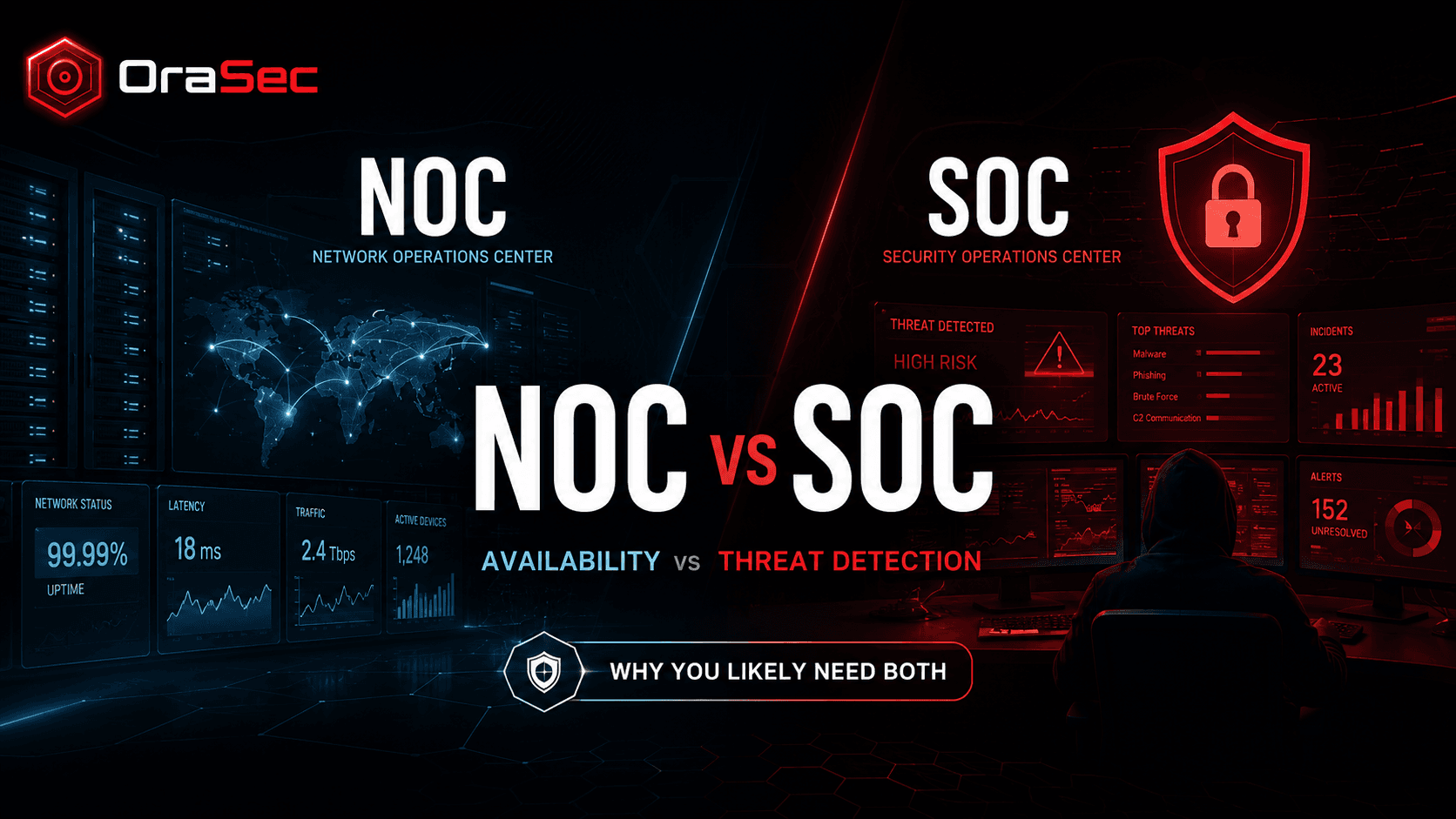
A NOC and a SOC both monitor technology environments, but they watch for different problems. Depending on the organization, coverage may be 24/7 or follow defined operating hours.
Treating them as competing options is the first mistake. One keeps systems running. The other keeps them defended. Most organisations need both operational monitoring and security monitoring, even if those functions are not separate teams.
What Is a NOC?
A Network Operations Center keeps infrastructure available and performing. NOC teams monitor uptime, bandwidth, latency, and hardware health, then respond when something degrades or fails.
NOC performance is commonly measured through availability, service health, uptime, and restoration time.
What Is a SOC?
A Security Operations Center monitors for threats. SOC analysts watch authentication events, network traffic, endpoint telemetry, and alerts from security tooling, then investigate what looks wrong.
SOC effectiveness is commonly measured through detection quality, investigation, containment, and response time.
What Are the Key Differences?
- Purpose. NOC targets availability and performance. SOC targets threat detection and response.
- Trigger. NOC responds to outages and degradation. SOC responds to suspicious behaviour.
- Tooling. NOC uses network monitoring and ticketing platforms. SOC uses SIEM, EDR, and threat intelligence.
- Skills. NOC staff specialise in networking. SOC analysts specialise in detection, forensics, and response.
- Adversary. NOC deals with failure. SOC deals with someone trying to avoid being seen.
That last difference is the important one. Hardware failure does not adapt when you start looking for it. An attacker does.
Why Does the Distinction Matter?
A NOC may notice unusual network behavior, but detecting a quiet intrusion is primarily a SOC function because the attack may not affect service availability. Microsoft specifically distinguishes NOC performance/availability monitoring from SOC threat detection and response. (Microsoft)
That is not a criticism of NOC teams. It is a description of what they are built to watch. Expecting network monitoring to catch credential abuse is a category error, not a staffing problem.
The reverse also applies. Capacity planning and routine network troubleshooting are normally operational responsibilities rather than core SOC functions.
Common Mistakes
- Assuming the NOC covers security. Availability monitoring and threat monitoring watch different signals.
- Buying tools without analysts. A SIEM without useful detections, tuning, and analyst review can create large alert volumes without providing effective detection.
- Measuring a SOC on alert volume. Useful SOC metrics include detection quality, false-positive rate, investigation time, containment time, and response effectiveness.
- Never testing whether detection works. An untested SOC is an assumption with a dashboard.
- Treating round-the-clock coverage as the answer. Monitoring only helps if someone can act on it.
Do You Need Both?
Larger environments often separate NOC and SOC responsibilities because the skills, tooling, and escalation paths differ. Smaller organisations may combine or outsource some of these functions.
Compliance requirements may increase the need for security monitoring and incident response. PCI DSS requires specific log reviews and security-event monitoring, while HIPAA requires audit controls and procedures for identifying and responding to security incidents. These requirements do not necessarily require an organization to operate a formal SOC.
The practical question is not which to choose. It is whether both functions are covered, by someone, with clear ownership.
What Should Security Testing Cover?
If you have a SOC, or pay for one, test it:
- Whether simulated attacks generate alerts at all
- How long detection takes from initial access to response
- Which stages of an attack chain go unnoticed
- Whether analysts escalate correctly, or close alerts as noise
- What an attacker reaches during the gap before anyone responds
A detection capability that has never been tested provides less assurance that it will work during a real attack.
How OraSec Can Help
OraSec runs red team engagements that test detection rather than just exposure. We simulate a real attack chain and measure what your SOC sees, what it misses, and how long response takes. You get evidence of where detection actually stands, not a coverage claim from a vendor dashboard.
Conclusion
NOC and SOC are not alternatives. They answer different questions: is it working, and is it under attack?
Decide what each function covers in your environment, make sure neither is assumed to handle the other's job, and test the security side rather than trusting it.
FAQs
What is the main difference between a NOC and a SOC? A NOC monitors infrastructure availability and performance. A SOC monitors for security threats and handles incident response. Different signals, different skills, different tooling.
Can a NOC handle cybersecurity tasks? It may catch security issues that cause visible network problems, but it is not equipped for threat detection generally. Quiet attacks produce no operational symptoms.
Should we build a SOC or outsource it? It depends on budget, existing skills, and compliance needs. Building in-house means recruiting scarce analysts and running shift cover, which is why many organisations start with a managed provider.
Do small businesses need a SOC? They need the function, not necessarily the building. Managed detection services cover it without the headcount.
How do we know if our SOC is effective? Test it. Red team exercises and attack simulations show what gets detected, what gets missed, and how quickly analysts respond.