Email is still one of the easiest ways attackers get into a business. They send fake messages that look real, trick employees into clicking links, and steal credentials, money, or data. But not every phishing attack is the same. Phishing, spear phishing, and whaling all use deception, but they target different people and use different tactics. Understanding the differences helps you train your team, build the right defenses, and reduce real risk. This guide explains how each attack works and breaks down the 10 key differences between phishing, spear phishing, and whaling.
What is Phishing?
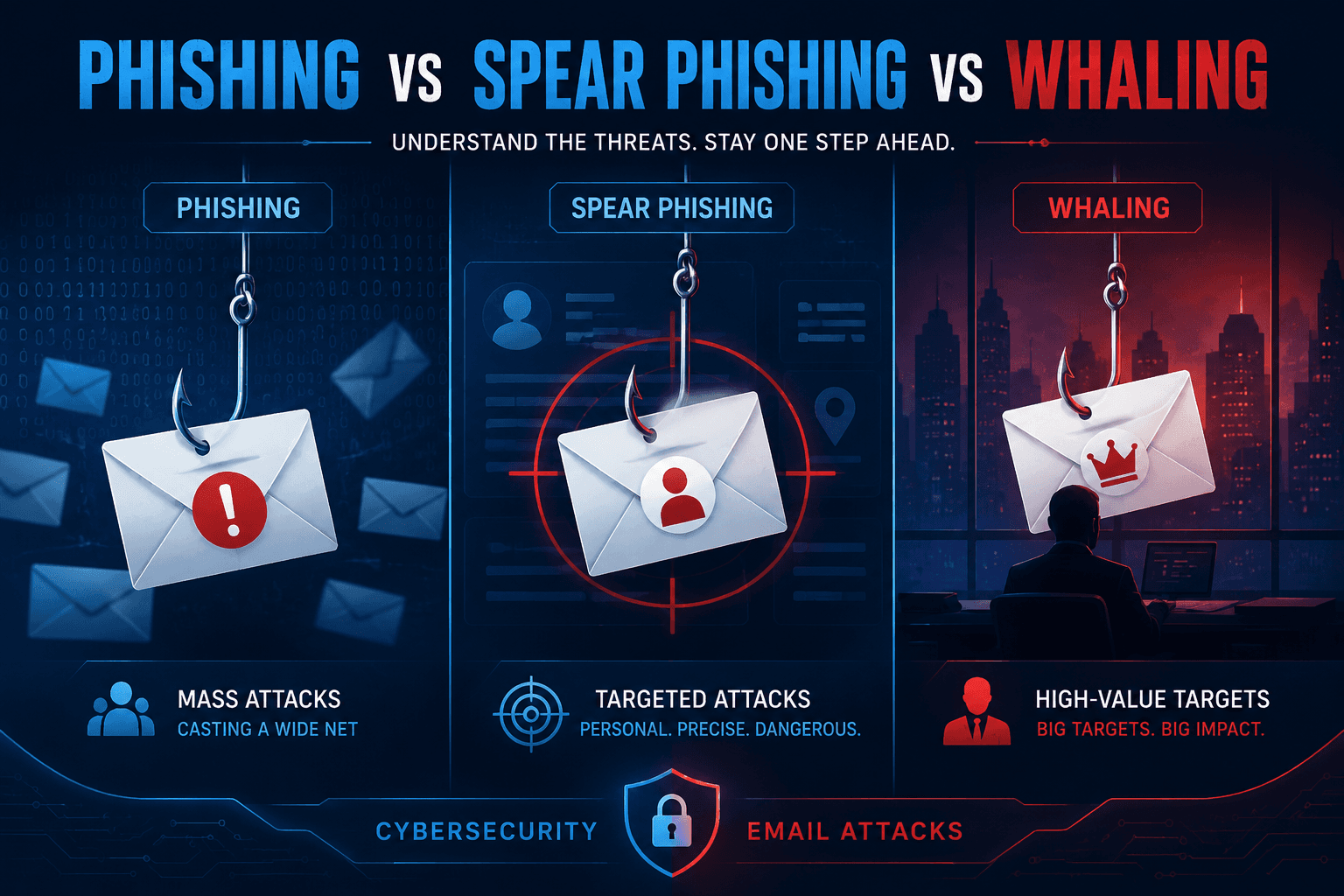
Phishing is a broad social engineering attack where attackers send mass emails, SMS, or messages to thousands of users at once. The goal is to trick anyone who clicks. Messages often pretend to be from banks, delivery services, or popular SaaS tools. They push users to click malicious links, enter credentials on fake pages, or download infected files. Phishing is a numbers game and works on a small percentage of targets, but the volume makes it highly profitable for attackers.
Also Read: Best Anti-Phishing Tools in 2026
What is Spear Phishing?
Spear phishing is a targeted attack focused on a specific person, team, or company. Attackers research the target using LinkedIn, company websites, breach data, and social media. Then they craft a personalized email that references real names, projects, vendors, or events. Because the message looks familiar and relevant, employees are far more likely to trust it. Spear phishing is often the first step in larger attacks like ransomware, business email compromise, and corporate espionage.
What is Whaling?
Whaling is a special form of spear phishing aimed at high-value targets like CEOs, CFOs, board members, and senior executives. Attackers spend weeks studying these "whales" to understand their tone, schedule, vendors, and signing power. Whaling messages often impersonate other executives, lawyers, or business partners and request urgent wire transfers, contracts, or sensitive data. The financial and reputational damage from a successful whaling attack can be massive, sometimes ending in millions of dollars lost in a single transaction.
Must Read: What Is Phishing-as-a-Service (PhaaS)
Key Differences Between Phishing, Spear Phishing, and Whaling
1. Target Audience
Phishing targets a wide, mostly random audience and is sent to thousands or millions of recipients at the same time without much personalization. Spear phishing focuses on specific individuals or small groups inside an organization, usually employees with access to important systems or data. Whaling goes one step further and targets only top executives such as CEOs, CFOs, or board members whose decisions and credentials can unlock major financial or strategic damage.
2. Level of Personalization
Phishing emails use generic greetings like "Dear customer" and rarely include personal details. Spear phishing messages are tailored to the target with names, job titles, recent projects, and vendor references gathered from public sources. Whaling takes personalization to the highest level, often using accurate organizational charts, internal terminology, and real business context to convince the executive that the message comes from a trusted source within or close to the company.
3. Research and Reconnaissance
Phishing usually requires very little research because attackers rely on volume rather than precision. Spear phishing involves moderate reconnaissance through LinkedIn, company websites, breach data, and social media. Whaling demands deep, long-term research where attackers study an executive's writing style, travel pattern, business partners, and decision-making habits. The more research behind the attack, the more believable the message becomes for the chosen target.
Helpful for you: How Attackers Sell Initial Access on the Dark Web
4. Attack Volume
Phishing is a high-volume attack, often sent to tens of thousands or even millions of inboxes in a single campaign. Spear phishing is medium-volume and limited to a select list of employees or departments inside specific companies. Whaling is low-volume, focused, and surgical because each message is crafted for one or a few high-value individuals at a time. The volume decreases as the level of targeting and impact increases.
5. Sophistication Level
Phishing emails are usually simple, sometimes full of typos and obvious red flags, because attackers expect only a small share of users to fall for them. Spear phishing is much more polished, with real names, professional language, and convincing context. Whaling is the most sophisticated, often involving spoofed domains, deepfake audio, fake vendor portals, and well-rehearsed business scenarios. Each step up in sophistication makes the attack harder for traditional filters to detect.
Must Read: Domain-Based Message Authentication Reporting & Conformance (DMARC)
6. Common Goals
Phishing attackers typically chase quick wins such as stolen passwords, credit card numbers, or malware installations on consumer devices. Spear phishing attackers aim for business credentials, internal system access, vendor data, or initial access for ransomware. Whaling attackers focus on high-value outcomes like large wire transfers, strategic data, mergers and acquisitions information, payroll redirection, and approval of fraudulent contracts. The bigger the target, the bigger the prize attackers expect.
7. Channels Used
Phishing is mostly delivered through email, SMS (smishing), and increasingly through messaging apps and social media. Spear phishing also uses these channels but adds business platforms like LinkedIn, Microsoft Teams, Slack, and corporate email. Whaling often combines email with phone calls (vishing), fake video calls, and deepfake voicemails impersonating executives or partners. The more critical the target, the more channels attackers are willing to combine to make the attack work.
8. Detection Difficulty
Phishing is the easiest to detect because email security tools, spam filters, and trained users catch many of these mass messages. Spear phishing is harder to detect because the messages look legitimate and often arrive from compromised partner mailboxes. Whaling is the hardest to detect because it bypasses many automated filters, uses real internal context, and arrives at a small number of inboxes. Stopping whaling depends heavily on executive awareness and strict approval processes.
You May Also Like: Defending Against Business Email Compromise
9. Business Impact
Phishing impact varies but usually stays at the individual level, such as a stolen account or one infected laptop. Spear phishing can cause serious damage, including ransomware outbreaks, data breaches, and customer data loss. Whaling has the largest business impact, with possible outcomes like multimillion-dollar wire fraud, leaked merger plans, regulatory penalties, and severe reputation damage. The same email-based technique can range from a minor nuisance to a company-ending event depending on the target.
10. Required Defenses
Phishing is best defended with strong email filters, basic awareness training, multi-factor authentication, and clear reporting buttons for suspicious messages. Spear phishing requires advanced email security, role-based training, simulated attacks, and tight access controls for sensitive systems. Whaling needs all of these plus strict financial approval workflows, executive coaching, deepfake awareness, and red team exercises that test how executives and their assistants respond under pressure. Defense complexity grows with the value of the target.
Phishing vs Spear Phishing vs Whaling: At a Glance
| Feature | Phishing | Spear Phishing | Whaling |
|---|---|---|---|
| Target | Mass, random users | Specific employees | Senior executives |
| Personalization | Low | High | Very high |
| Volume | Very high | Medium | Very low |
| Sophistication | Basic | Advanced | Highly advanced |
| Main Goal | Credentials, malware | Business access | Wire fraud, big data |
| Channels | Email, SMS | Email, LinkedIn, chat | Email, voice, deepfake |
| Detection | Easier | Harder | Hardest |
| Business Impact | Low to medium | High | Critical |
Pros and Cons of Each Attack from an Attacker's View
Understanding why attackers choose each method helps defenders prepare better.
Phishing
- Pros: Low effort, easy to launch, works at scale, hard to attribute to one actor.
- Cons: Low success rate per email, easily blocked by modern filters, weak return on high-value targets.
Spear Phishing
- Pros: Much higher success rate, can bypass basic filters, opens doors to internal systems.
- Cons: Requires research and time, more chance of detection if recon is sloppy, harder to scale.
Whaling
- Pros: Highest possible payout, often bypasses standard controls, can trigger huge wire transfers.
- Cons: Demands deep research, long preparation, more legal exposure, and stronger investigation after success.
How to Choose the Right Defense Approach
- Treat phishing, spear phishing, and whaling as different threats with overlapping defenses.
- Combine email security tools, MFA, awareness training, and simulated phishing for everyone.
- Add executive-focused programs with stricter rules around money movement and sensitive data.
- Use red team exercises to test how staff respond to advanced spear phishing and whaling scenarios.
- Review incident response and reporting flows often, so suspicious messages reach the security team fast.
How Orasec Can Help You?
Orasec helps you defend against all three attack types with realistic Social Engineering and Phishing Simulation services. We design custom phishing, spear phishing, and whaling scenarios based on your industry, tools, and people. You get real metrics on click rates, credential entry, and executive response, plus clear training recommendations. With Orasec, your team learns from controlled attacks instead of real ones and your business becomes a much harder target for email-based threats.
Conclusion
Phishing, spear phishing, and whaling all rely on the same core trick: convincing a human to act fast and trust the message. The difference is in scale, targeting, and impact. Phishing casts a wide net, spear phishing aims at chosen employees, and whaling hunts the top of the org chart. By understanding how each one works and where they overlap, you can build defenses that protect both regular users and senior executives. A strong mix of technology, training, and testing is the only way to stay ahead of these evolving attacks.
FAQs
What is the main difference between phishing, spear phishing, and whaling?
Phishing is a mass attack with little personalization. Spear phishing targets specific employees with researched, customized messages. Whaling is a focused attack on senior executives like CEOs or CFOs, usually aiming at large financial fraud.
Which attack is the most dangerous for businesses?
Whaling is usually the most dangerous because it targets high-value executives and can lead to massive wire fraud or data leaks. However, widespread phishing and spear phishing can cause serious damage at scale across many users.
Can email filters stop all phishing attacks?
No. Email filters block many mass phishing emails but often miss well-crafted spear phishing and whaling messages. You need a layered defense that combines filtering, MFA, user training, and simulated attacks to reduce real-world risk.
How can employees spot spear phishing or whaling emails?
They should check sender addresses carefully, look for urgent or unusual financial requests, verify out-of-band through a known number, and report anything suspicious to the security team instead of replying directly to the email.
Do small businesses face whaling attacks?
Yes. Attackers know small businesses also have CEOs, CFOs, and finance staff who can approve payments. Smaller companies often have weaker controls, which makes them attractive targets for whaling and business email compromise scams.