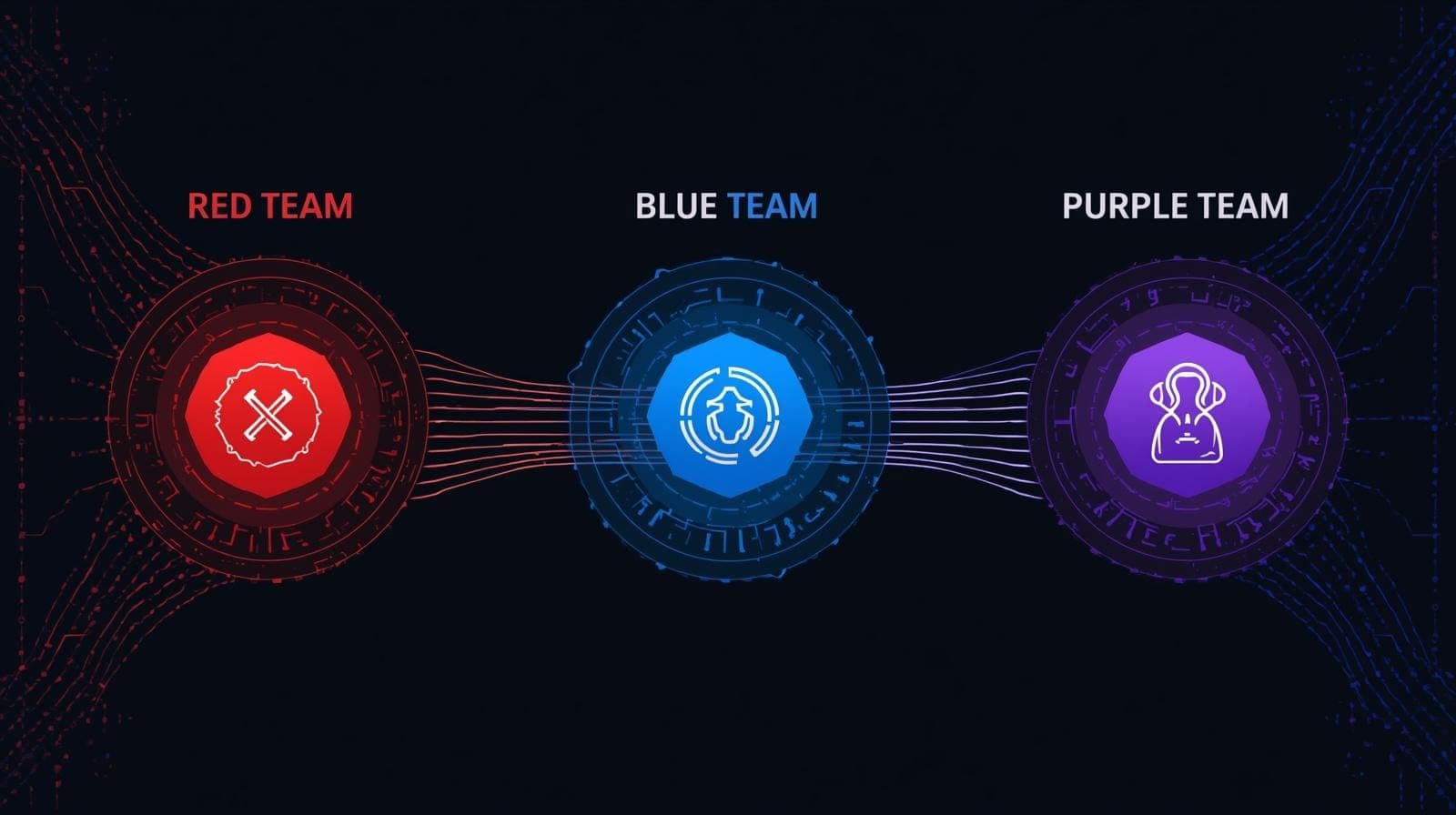
Nowadays, cybersecurity is not only about building defenses but also about challenging them as an attacker would. The modern threats are so well co-ordinated and fast-moving that they are typically able to bypass traditional security controls. This is the main reason why organizations are now engaging Red Teams, Blue Teams, and Purple Teams to simulate real attack scenarios, find security gaps, and regularly enhance their security measures. The role of each team is to identify vulnerabilities, protect systems, and transform security findings into effective changes. In this blog, you will discover how these teams function and what differentiates them, and how organizations utilize them together to create stronger and more resilient cybersecurity strategies.
Also Read: Penetration Testing vs Vulnerability Assessment
What is Red Team
Red Teams are offensive security experts who simulate real-world attacks to identify vulnerabilities in applications, networks, and human processes. They emulate attackers using advanced techniques, including phishing, social engineering, and exploitation of software vulnerabilities. Red Teams provide organizations with insight into potential risks, attack paths, and business impacts, enabling prioritization of defenses and proactive mitigation strategies. Their work is essential for testing the effectiveness of security policies and uncovering weaknesses that automated scans or Blue Team monitoring might miss.
Helpful for you: The Future of Red Teaming
What is Blue Team
Blue Teams focus on defensive cybersecurity measures to protect an organization’s systems, networks, and sensitive data. They implement monitoring, threat detection, incident response, and mitigation strategies to prevent attacks from succeeding. Blue Teams analyze logs, detect anomalies, and respond to incidents in real-time, ensuring business continuity and regulatory compliance. Their work includes vulnerability management, policy enforcement, and continuous threat intelligence integration to improve the organization’s overall security posture.
What is Purple Team
Purple Teams combine offensive Red Team strategies with Blue Team defensive operations to maximize cybersecurity effectiveness. They facilitate collaboration, ensure lessons from Red Team exercises improve Blue Team defenses, and refine detection and response strategies. Purple Teams help organizations implement continuous improvement, reduce response time, and strengthen the ability to prevent breaches. Their focus is on knowledge sharing, iterative testing, and integrating attack simulations into actionable defense measures, improving overall resilience against evolving cyber threats.
Must Read: Best Ways to Speed Up Alert Triage for SOC Team
Key Tools Used by Red Team
- Penetration testing frameworks like Metasploit and Cobalt Strike for simulating attacks.
- Social engineering and phishing simulation tools to test human vulnerabilities.
- Exploit development and vulnerability scanning platforms to identify hidden weaknesses.
- Custom scripts for privilege escalation, lateral movement, and advanced attacks.
- Attack simulation and threat emulation platforms to replicate real-world cyber threats effectively.
Key Tools Used by Blue Team
- Security Information and Event Management (SIEM) tools like Splunk or ELK Stack for continuous monitoring.
- Intrusion Detection and Prevention Systems (IDS/IPS) to detect anomalies and threats.
- Endpoint Detection and Response (EDR) solutions for proactive defense.
- Log management and network traffic analysis tools for threat investigation.
- Vulnerability management platforms for patching and mitigation across systems.
Key Tools Used by Purple Team
- Collaboration platforms to integrate Red Team findings into Blue Team workflows.
- Combined SIEM and penetration testing tools for feedback-driven security improvements.
- Threat simulation and testing tools to evaluate defensive responses in real scenarios.
- Incident response dashboards that track remediation of vulnerabilities identified by Red Teams.
- Reporting and analytics tools to measure improvement in detection, mitigation, and overall security posture.
You May Also Like: What is a Host-based Intrusion Detection System?
When to Use Red Team
| Use Case | Reasoning |
|---|---|
| Simulating advanced attacks | To identify hidden vulnerabilities, test defenses, and reveal realistic attack paths before malicious actors exploit them. |
| Evaluating critical assets | Focused testing ensures sensitive systems and high-value data are protected from sophisticated threats. |
| Employee security testing | Phishing and social engineering reveal human-related vulnerabilities for better training. |
| Compliance preparation | Helps meet regulatory standards by realistically testing policies and controls. |
| Incident response validation | Confirms the readiness of Blue Team defenses and incident response plans. |
When to Use Blue Team
| Use Case | Reasoning |
|---|---|
| Continuous monitoring | To detect threats early and maintain operational security at all times. |
| Incident response | Rapid detection and containment prevent significant data loss or downtime. |
| Patch and vulnerability management | Reduces exposure to exploitable vulnerabilities proactively. |
| Security audits | Ensures compliance with regulatory frameworks and internal policies. |
| Threat intelligence integration | Enhances detection capabilities by leveraging actionable threat data. |
When to Use Purple Team
| Use Case | Reasoning |
|---|---|
| Improving collaboration | Integrates Red Team insights into Blue Team defenses to accelerate improvements. |
| Testing defensive effectiveness | Validates whether security controls mitigate real attack scenarios. |
| Continuous learning | Provides iterative feedback for ongoing security posture enhancement. |
| Bridging offensive and defensive strategies | Ensures lessons from attacks are translated into actionable defense measures. |
| Optimizing resource allocation | Helps prioritize vulnerabilities that require immediate remediation based on attack simulation results. |
Key Differences Between Red Team, Blue Team, and Purple Team
1. Purpose
- Red Team: Offensive attack simulations to uncover hidden vulnerabilities, potential exploits, and real-world attack paths across networks, applications, and human systems to assess organizational risk effectively.
- Blue Team: Focuses on defense, continuous monitoring, threat detection, and incident response to prevent attacks, maintain operational continuity, and protect sensitive business data.
- Purple Team: Integrates Red Team offensive findings into Blue Team defensive actions for continuous improvement, knowledge sharing, and strengthened organizational security posture.
2. Approach
- Red Team: Uses manual and automated attacks, social engineering, phishing campaigns, and creative techniques to replicate sophisticated attacker behavior and discover security gaps.
- Blue Team: Monitors, defends, and analyzes systems using automated tools, alerts, threat intelligence, and logs to detect anomalies and mitigate risks proactively.
- Purple Team: Facilitates collaboration, iterative testing, and learning between Red and Blue Teams, ensuring actionable improvements are implemented for robust security defenses.
3. Scope
- Red Team: Targets high-value assets, sensitive data, privileged accounts, and attack path discovery to simulate realistic, multi-layered attacks across organizational systems.
- Blue Team: Covers the entire network, endpoints, cloud, and compliance frameworks to maintain comprehensive protection and prevent threats from escalating into incidents.
- Purple Team: Operates across both offense and defense to ensure Red Team insights are translated into actionable Blue Team improvements and overall security optimization.
4. Frequency
- Red Team: Conducted periodically for targeted audits, major updates, or compliance testing, providing realistic insights into potential risks from advanced attacks.
- Blue Team: Continuous 24/7 monitoring, detection, and defense of systems and networks to identify threats early and ensure uninterrupted business operations.
- Purple Team: Ongoing collaboration and iterative improvement of defenses, using insights from Red Team simulations to strengthen response and mitigation strategies.
5. Skill Requirement
- Red Team: Requires highly skilled ethical hackers with expertise in penetration testing, exploit development, social engineering, and advanced attack methodologies.
- Blue Team: Security analysts skilled in monitoring, incident response, threat intelligence, and forensic analysis to detect and mitigate potential attacks effectively.
- Purple Team: Professionals proficient in both offensive and defensive strategies to coordinate cross-team efforts and implement actionable improvements efficiently.
6. Output
- Red Team: Delivers detailed attack simulations, vulnerability exploitation paths, business impact assessments, and actionable remediation recommendations for improved security.
- Blue Team: Provides alerts, logs, mitigation actions, and continuous monitoring metrics to track defense performance and system security status.
- Purple Team: Generates collaborative recommendations combining Red Team insights with Blue Team processes, validating improvements and strengthening organizational defenses.
7. Risk Exposure
- Red Team: Temporarily increases risk during testing to uncover vulnerabilities realistically before malicious attackers can exploit them.
- Blue Team: Minimizes risk by proactively protecting systems, monitoring activities, and responding to threats in real-time.
- Purple Team: Balances offensive insights and defensive controls to safely test, validate, and improve security measures across the organization.
8. Tools
- Red Team: Penetration testing frameworks, exploit kits, phishing and social engineering platforms, vulnerability scanners, and custom attack scripts.
- Blue Team: SIEM solutions, IDS/IPS, EDR platforms, log management tools, threat intelligence feeds, and automated alert systems.
- Purple Team: Combines offensive and defensive tools, including Red Team frameworks, SIEM monitoring, dashboards, and incident response platforms for integrated testing.
9. Focus Area
- Red Team: Focuses on identifying hidden vulnerabilities, simulating advanced attacks, mapping attack paths, and assessing real-world risk to critical assets.
- Blue Team: Concentrates on threat detection, prevention, response, maintaining continuity, and monitoring systems for anomalies or malicious activity.
- Purple Team: Converts Red Team insights into actionable defensive improvements, strengthening detection, mitigation, and incident response across all systems.
10. Business Value
- Red Team: Reveals hidden risks, validates system defenses, highlights attack paths, and improves organizational readiness against sophisticated threats.
- Blue Team: Maintains operational continuity, protects sensitive information, ensures compliance, and provides ongoing defense against cyber threats.
- Purple Team: Improves security resilience, reduces risk gaps, fosters collaboration, accelerates remediation, and ensures continuous improvement across cybersecurity operations.
11. Reporting and Metrics
- Red Team: Produces detailed reports with attack paths, exploited vulnerabilities, business impact analysis, and remediation recommendations for decision-making.
- Blue Team: Offers monitoring dashboards, alert logs, compliance reports, and performance metrics to maintain operational security and evaluate defenses.
- Purple Team: Provides integrated metrics combining Red and Blue Team findings, highlighting improvements in detection, response, and overall risk reduction.
12. Cost Implication
- Red Team: High due to skilled personnel, manual testing, attack simulation complexity, and detailed reporting required to uncover hidden vulnerabilities effectively.
- Blue Team: Moderate ongoing investment for monitoring tools, staffing, threat detection, and incident response to maintain continuous protection.
- Purple Team: Additional cost for collaboration, integrated tools, and coordination, but significantly reduces overall security gaps while enhancing organizational resilience over time.
Red Team vs Blue Team vs Purple Team in a Nutshell
| Feature | Red Team | Blue Team | Purple Team |
|---|---|---|---|
| Purpose | Offensive attack simulation | Defensive monitoring and mitigation | Collaborative integration of attack and defense insights |
| Frequency | Periodic, project-based | Continuous | Continuous and iterative |
| Tools | Pen testing frameworks, phishing tools | SIEM, IDS/IPS, EDR | Combined offensive and defensive tools |
| Skill Level | Advanced hacking and simulation | Security monitoring and response expertise | Understanding both offensive and defensive techniques |
| Output | Attack paths, vulnerabilities, reports | Alerts, logs, remediation | Integrated recommendations for continuous improvement |
| Risk Exposure | High during testing | Low to moderate | Balanced and controlled |
| Goal | Identify hidden vulnerabilities | Protect assets and maintain security | Improve security posture via collaboration |
Pros and Cons of Red Team
Pros of Red Team
- Reveals hidden vulnerabilities and attack paths realistically.
- Tests security defenses against advanced threats effectively.
- Provides actionable reports for risk mitigation and improvement.
- Helps meet regulatory compliance through realistic testing.
- Trains security teams to respond to real-world scenarios proactively.
Cons of Red Team
- Expensive due to manual testing and skilled personnel.
- Increases temporary risk during testing activities.
- Requires careful planning to prevent operational disruption.
- Cannot be continuous due to resource requirements.
- Findings need collaboration to translate into effective defense improvements.
Pros and Cons of Blue Team
Pros of Blue Team
- Continuous monitoring of networks and systems.
- Rapid detection, containment, and mitigation of threats.
- Maintains operational continuity and data integrity.
- Supports compliance and security governance.
- Leverages threat intelligence for proactive defense.
Cons of Blue Team
- May miss hidden vulnerabilities without offensive testing.
- Resource-intensive for monitoring and analysis.
- Detection limited by predefined rules or automation.
- Reactive if not integrated with Red Team insights.
- Advanced attacks may bypass defenses without proactive exercises.
Pros and Cons of Purple Team
Pros of Purple Team
- Facilitates collaboration between Red and Blue Teams.
- Improves detection, response, and mitigation strategies.
- Accelerates remediation of vulnerabilities identified by Red Teams.
- Provides continuous learning and security improvement.
- Enhances overall organizational resilience and risk reduction.
Cons of Purple Team
- Requires staff skilled in both offensive and defensive security.
- Resource-intensive for tool integration and collaboration.
- Needs organizational commitment for effective coordination.
- Complexity increases with larger teams or infrastructures.
- Requires ongoing communication and reporting to maximize impact.
How to Choose the Right Approach for Your Business
- Identify business-critical assets, systems, and sensitive data to prioritize testing.
- Determine whether offensive, defensive, or collaborative capabilities are needed.
- Evaluate available resources, budget, and skill levels of security personnel.
- Consider compliance, audit requirements, and regulatory standards.
- Assess the potential impact of attacks on business continuity and reputation.
- Decide on phased implementation: start with Red or Blue Teaming and integrate Purple Team for collaboration.
- Monitor results and refine approaches continuously for maximum cybersecurity resilience.
How Orasec Can Help You?
Orasec provides AI red teaming services & solutions to help organizations identify vulnerabilities, simulate realistic attacks, and strengthen defenses. Our experts perform advanced threat simulations, integrate AI-driven insights, and collaborate with Blue Teams to improve detection, response, and overall security posture. Partnering with Orasec ensures actionable recommendations, continuous security improvement, and robust protection against evolving cyber threats.
Conclusion
Red Team, Blue Team, and Purple Team approaches are essential for modern cybersecurity. Red Teams simulate attacks, Blue Teams defend systems, and Purple Teams integrate offensive findings into actionable improvements. Combining these strategies improves detection, response, mitigation, and overall resilience against cyber threats. Organizations leveraging these teams, alongside expert services like Orasec’s Red Teaming and AI Red Teaming Solutions, can maintain strong security, protect sensitive assets, and stay ahead of evolving threats.
FAQs
What is the difference between Red, Blue, and Purple Teams?
Red Teams simulate attacks, Blue Teams defend and monitor systems, and Purple Teams integrate both approaches to improve security continuously.
When should I use a Purple Team?
Use Purple Teams to facilitate collaboration, validate defenses, and ensure lessons from Red Team exercises translate into actionable Blue Team improvements.
Can AI improve Red Teaming?
Yes, AI-driven Red Teaming enables advanced attack simulation, automated vulnerability detection, and more efficient threat analysis to enhance security testing.
Are Blue Team operations always continuous?
Yes, Blue Teams operate 24/7 to monitor, detect, and respond to threats in real-time, ensuring business continuity.
How can Orasec help with Red Teaming?
Orasec provides Red Teaming Services & AI Red Teaming Solutions, helping organizations simulate attacks, identify vulnerabilities, and strengthen overall security posture effectively.