AI agents can do more than answer questions. They can read files, call APIs, access repositories, use tools, and trigger workflows.
If an attacker influences what an agent reads, the agent may take an unintended action using its own permissions. This is why AI agent security matters.
What Is AI Agent Security?
AI agent security protects AI systems that can access data, use tools, call APIs, and perform actions.
Unlike a chatbot, an AI agent may connect to cloud services, source code, internal APIs, databases, or CI/CD pipelines.
The key question is what the agent can do if it is manipulated.
Also Read: How Prompt Injection Attacks Bypass AI Agent Security
What Is Prompt Injection?
Prompt injection happens when crafted input changes an AI model’s behaviour in an unintended way. OWASP lists Prompt Injection as LLM01:2025.
Direct prompt injection is sent straight to the AI interface.
Indirect prompt injection is hidden inside content that the agent later reads, such as an email, document, website, GitHub issue, API response, or RAG source.
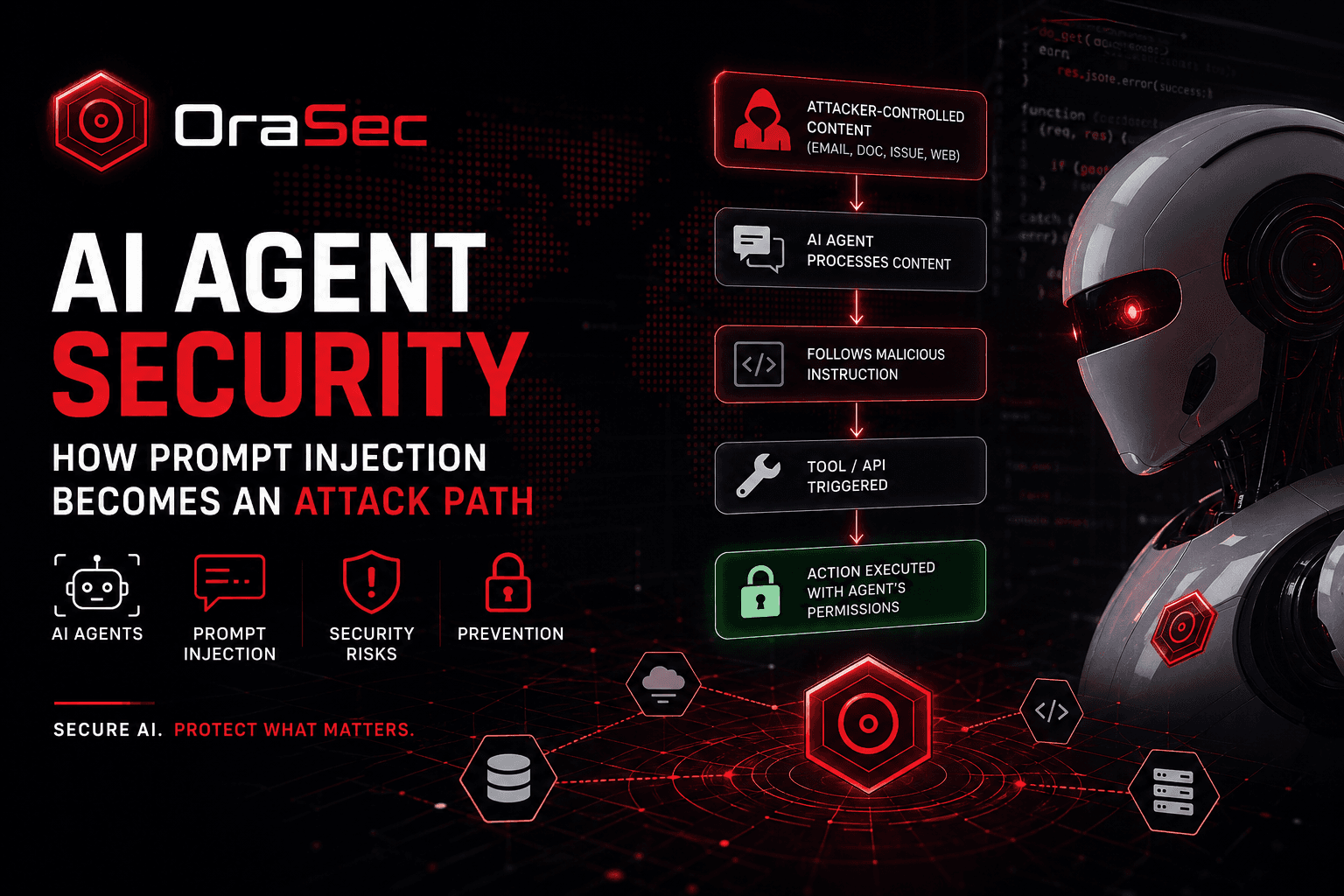
How Prompt Injection Becomes an Attack Path
Prompt injection becomes more dangerous when an agent can access sensitive data, privileged tools, credentials, or external systems.
Attacker-Controlled Content
↓
AI Agent Reads It
↓
Agent Follows an Unintended Instruction
↓
Tool or API Is Triggered
↓
Action Runs With the Agent’s Permissions
The main mistake is treating model output as authorization.
An AI model can suggest an action, but it should not decide whether that action is allowed.
Authorization should be enforced by application logic, IAM controls, or human approval.
Why AI Agents Can Be Riskier Than Chatbots
A chatbot usually returns text. An AI agent can take action.
A manipulated agent may:
- Call internal APIs
- Read sensitive files
- Modify code
- Trigger workflows
- Access cloud resources
- Use service credentials
Helpful for you: Penetration Testing in the Age of Large Language Models
Real-World AI Agent Security Risk
Pillar Security research showed how prompt injection in AI-powered GitHub workflows could create software supply-chain risk.
Researchers found workflow patterns where untrusted repository content could influence Gemini-powered automation with access to tools and credentials. Google later updated the affected components and strengthened tool allowlisting.
This shows why AI workflows that process untrusted content need strict permission and tool controls.
Common AI Agent Security Risks
Excessive Agency
An agent may have more capabilities than its task requires.
Overprivileged Credentials
Long-lived API keys, tokens, and service accounts can increase attack impact.
Unsafe Tool Access
Agents that execute commands, modify files, or call sensitive APIs need strict controls.
Weak Trust Boundaries
Low-trust agents should not automatically trigger privileged workflows.
Sensitive Data Exposure
Agents that read confidential information and communicate externally may create a data-leak path.
How to Secure AI Agents
Use Least Privilege
Give each agent only the permissions required for its task.
Treat External Content as Untrusted
Assume emails, websites, documents, repositories, API responses, and RAG content may contain malicious instructions.
Enforce Authorization Outside the Model
Use application logic, IAM controls, approval workflows, or human verification for sensitive actions.
Restrict Tool Access
Allow only approved tools. High-risk actions should require stronger controls.
Sandbox Code Execution
Run code in isolated environments that cannot freely access production systems or secrets.
Use Short-Lived Credentials
Limit the scope and lifetime of tokens, API keys, and service accounts.
Monitor and Test
Log tool calls, API requests, file access, and workflow triggers. Test direct and indirect prompt injection before production.
OWASP also recommends regular penetration testing of trust boundaries and access controls around LLM applications.
What Should AI Agent Security Testing Cover?
A complete AI security assessment should test:
- Direct and indirect prompt injection
- Excessive agency and tool abuse
- API security and authorization
- Agent-to-agent trust
- Sensitive data and credential exposure
- RAG security
- Unsafe output handling
- Code execution
- CI/CD and cloud integrations
How Orasec Can Help
Orasec’s AI and LLM security testing covers prompt injection, tool abuse, RAG security, API authorization, sensitive data exposure, unsafe output handling, and AI infrastructure risks.
Our testers verify whether attacker-controlled input can reach sensitive systems or trigger unauthorized actions.
Conclusion
AI agent security is not only about blocking malicious prompts. The bigger goal is controlling what happens if a model is manipulated.
Least privilege, strong authorization, restricted tools, isolated execution, limited credentials, monitoring, and regular testing reduce the blast radius.
The key principle is simple:
The security boundary should exist around the AI agent, not inside its prompt.
FAQs
What is AI agent security?
It protects AI systems that access data, use tools, call APIs, or perform actions from manipulation.
What is prompt injection?
It uses crafted input to change an AI model’s intended behaviour.
What is indirect prompt injection?
It happens when malicious instructions are hidden inside content an AI system later processes.
Why are AI agents riskier than chatbots?
They can perform real actions, including calling APIs, accessing files, using credentials, and triggering workflows.
How can organizations secure AI agents?
Use least privilege, strong authorization, restricted tools, sandboxing, monitoring, short-lived credentials, and regular security testing.