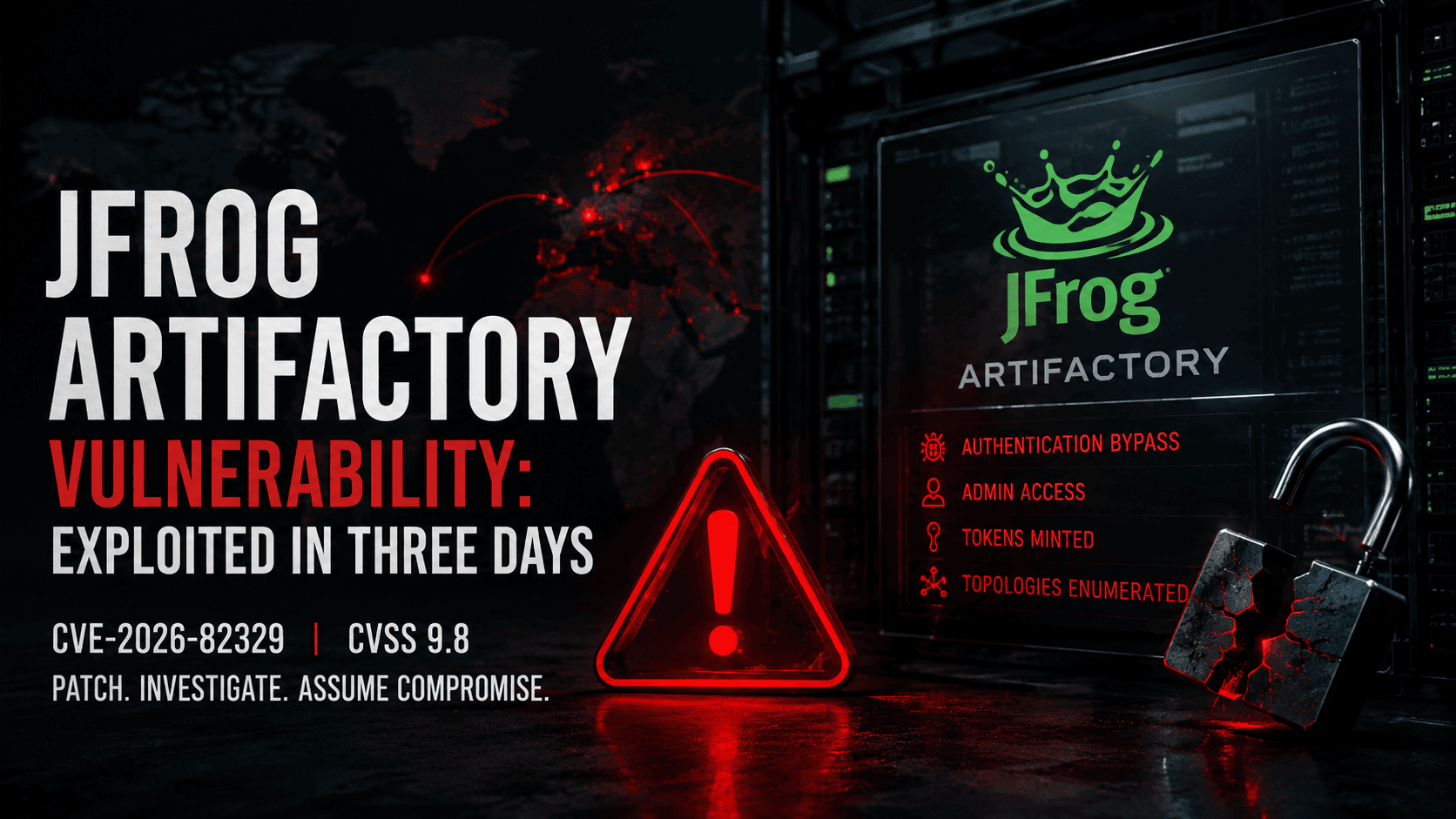
JFrog released patches on 28 August 2026. By 1 September, watchTowr was publicly reporting active exploitation — roughly three and a half days after disclosure.
What Is the Vulnerability?
CVE-2026-82329 is an authentication bypass in JFrog Artifactory, rated CVSS 9.8. In default configurations, an unauthenticated attacker with network access can obtain administrative privileges, with no user interaction required.
Self-hosted deployments require customer action. JFrog says affected cloud environments were already fortified, so no action is required for cloud instances.
Fixed releases are 7.111.21, 7.117.28, 7.125.20, 7.133.29, 7.146.38, and 7.161.20.
What Are Attackers Doing With It?
According to watchTowr telemetry, attackers are minting administrator tokens and enumerating users, groups, credential sets, and federated access topologies.
Activity so far looks opportunistic, coming from a small number of IP addresses across varying geographies and involving more than one actor. watchTowr says broad-scale scanning and mass exploitation have not yet been observed, but expects that to change.
Pruva published a verified proof-of-concept reproduction, while researcher Souhaib Naceri also reported independently reproducing the vulnerability. Public proof-of-concept code significantly lowers the barrier to exploitation and can accelerate broader scanning.
Why Does It Matter?
Artifactory holds build artifacts, container images, packages, and AI models, along with the credentials that let pipelines and deployment targets pull them.
Administrative access means tampering with packages before they are consumed, reading credentials for connected systems, and changing configuration.
Enumerating credential sets and federated access topologies suggests attackers may be mapping where the compromised Artifactory environment could lead next.
What Should You Do Now?
- Patch to one of the fixed releases
- If the instance was reachable from the internet before patching, treat it as potentially compromised rather than fixed
- Review audit logs for token creation, new admin accounts, and permission changes
- Rotate potentially exposed credentials and revoke or reissue suspicious or exposed access tokens
- Check what authenticates to Artifactory, including build pipelines and deployment targets
- Look for malicious changes to artifacts, repositories, users, permissions, tokens, and connected systems
Why the Three Days Matter More Than the CVSS
What made this urgent was the combination of public disclosure, rapidly available technical reproduction, default configurations being vulnerable, and internet-reachable instances.
CVSS captures some exploitability characteristics — such as network reachability, low attack complexity, no required privileges, and no user interaction — but it does not capture active exploitation, public PoC availability, exposure prevalence, or patch-to-exploitation velocity.
This is the argument for prioritising by exploitability rather than by score alone.
Common Mistakes
- Treating build infrastructure as internal. Artifactory is routinely exposed so remote developers and cloud CI runners can reach it.
- Patching and stopping. Compromise may persist through previously issued tokens, added accounts, altered permissions, or other malicious changes.
- Not knowing what authenticates to the repository. Rotation is guesswork without that list.
- Applying a slower patch SLA to developer tooling. It may hold credentials and trust relationships used by downstream systems.
- Waiting for a KEV listing before acting. Public exploitation can precede any catalogue entry by days. At the time of writing, CVE-2026-82329 was not listed in the CISA KEV catalogue.
How to Reduce the Risk
- Remove artifact repositories from direct internet exposure, and route access through a gateway
- Issue short-lived tokens scoped to individual pipelines rather than long-lived admin credentials
- Alert on administrative token creation and permission changes
- Keep an inventory of every system that authenticates to the repository
- Sign artifacts and verify signatures at consumption
What Should Security Testing Cover?
Ask your testers to establish:
- Whether artifact repositories or build systems are reachable from outside your network
- What a compromised repository administrator can reach downstream
- Whether artifact tampering would be detected before deployment
- Whether administrative token creation generates an alert anyone acts on
- How quickly a critical patch reaches developer infrastructure
How OraSec Can Help
Build infrastructure sits between development and production, where neither team's testing scope always reaches. OraSec's external penetration testing maps what is actually exposed, and Pentia's continuous testing finds newly exposed systems between assessments.
Conclusion
The interesting number here is not 9.8. It is three.
A patch published on Friday and exploited by Monday assumes an organisation that can act inside a working week. If your developer infrastructure runs on a slower cycle than production, this is what will find that out.
FAQs
Which versions are affected? Self-hosted Artifactory before any of the fixed releases listed above, depending on your release branch. JFrog's SaaS platform is not affected.
Is patching enough? Patching fixes the vulnerability, but if an affected instance was exposed to untrusted networks or otherwise reachable by an attacker while vulnerable, investigate it for compromise as well.
What does an attacker get? Administrative control over Artifactory repositories, artifacts, users, tokens, and configuration, with potential access to credential sets and trust relationships used by connected systems.
How would we know if we were hit? Look for unexpected admin token creation, new accounts or permissions, and enumeration of users and credential sets in the audit log.