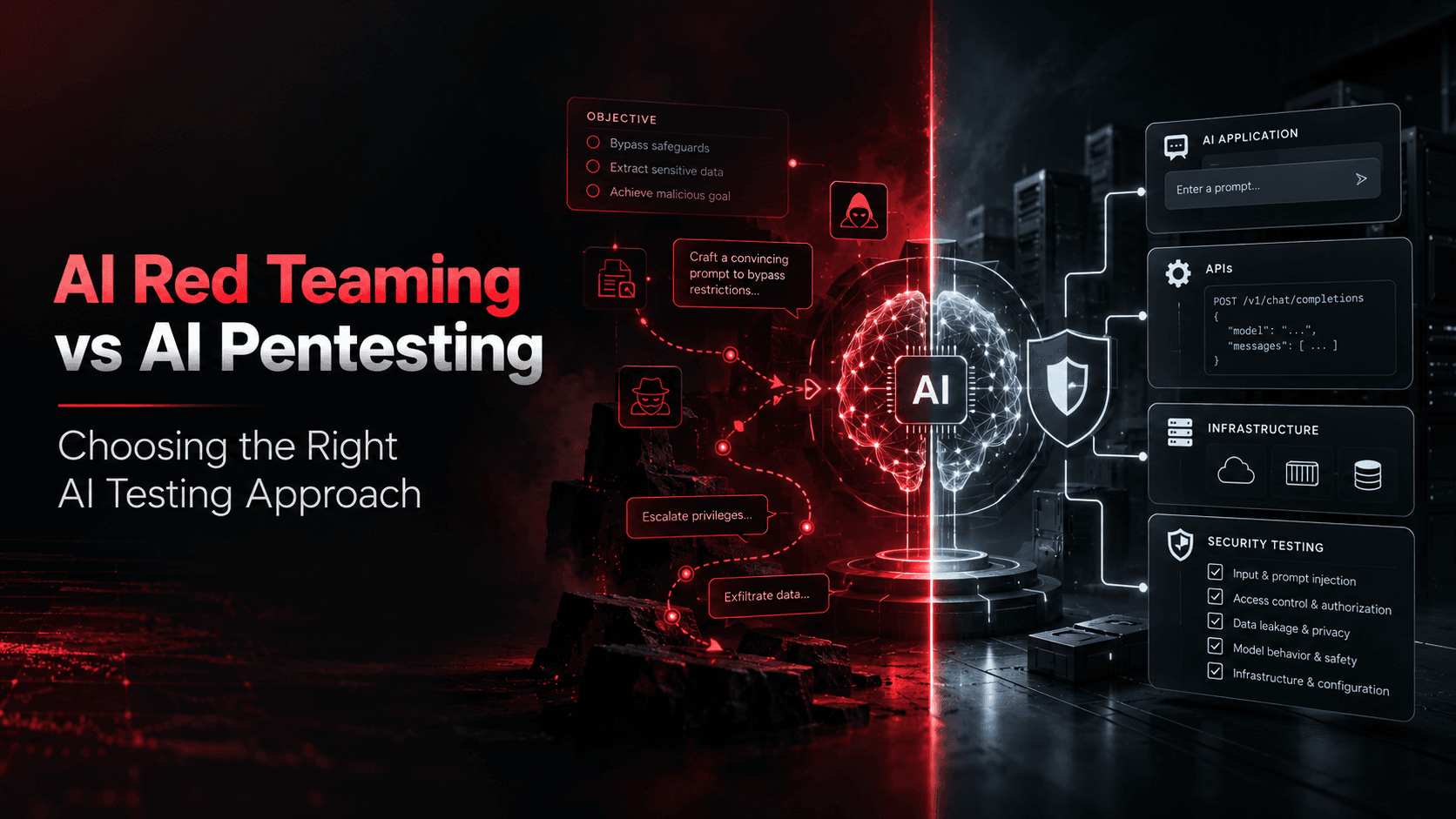
AI red teaming and AI pentesting both attack your AI systems before someone else does, but they answer different questions. A pentest asks what vulnerabilities exist and how far they can be exploited. A red team asks whether a determined adversary could reach a specific goal, and whether anyone would notice. AI systems can fail like any web application, and in new ways that come from the model itself. Good AI and LLM security testing covers both.
What is AI red teaming?
An objective-based exercise where testers act as a realistic adversary, pursuing specific goals against an AI system and its defenses.
What is AI penetration testing?
A scoped, time-boxed assessment that finds, proves, and reports exploitable vulnerabilities in an AI application and its supporting systems.
What is the difference between AI red teaming and AI pentesting?
Pentesting aims for broad coverage of a defined scope. Red teaming tests whether an adversary can reach a specific goal.
When should you choose AI red teaming over AI pentesting?
Choose it to test realistic attacks, misuse, or harmful outcomes, especially for high-risk applications and agents.
Can AI red teaming and AI pentesting be used together?
Yes. They can run in either order or side by side, and findings from each improve the other.
Key Takeaways
- Pentesting finds exploitable vulnerabilities in a defined scope. Red teaming tests whether an adversary can reach a goal.
- AI systems can inherit classic application flaws and add new ones, such as prompt injection and excessive agency.
- Some serious AI security failures have been ordinary infrastructure mistakes, not attacks on the model.
- The more an AI system can do, the more it needs goal-based testing.
- Pentesting first, then red teaming, is a common sequence, not a requirement.
- Authorization belongs in code, never in model output.
- Models, prompts, and data change often, so testing must be repeated.
What Is AI Red Teaming?
AI red teaming applies the red team mindset to AI systems. The team gets an objective, such as making an agent change a record it shouldn't touch, and uses any realistic path: the model, poisoned content, tools, or infrastructure. They also check whether anyone notices. The term has two meanings in the AI world:
- Security red teaming: compromising confidentiality, integrity, or availability through the AI system.
- Safety or responsible AI red teaming: finding harmful, biased, or false output.
What Is AI Penetration Testing?
AI penetration testing follows the same penetration testing methodology as any other pentest, across more layers:
- The model interface: prompt injection, jailbreaking, hidden context extraction, and unsafe output handling.
- The application and APIs: authentication, sessions, user and tenant authorization, and rate limits.
- Tools, plugins, and agents: which actions the model can trigger, and with whose permissions.
- Retrieval (RAG) pipelines: who can add content and who can retrieve it.
- Infrastructure: model endpoints, vector databases, training pipelines, secrets, and cloud configuration.
The OWASP Top 10 for LLM Applications (2025 edition) is a good baseline for AI-specific test cases. Many findings are not new, though. An assistant that fetches data by ID can carry the same flaw as the hotel loyalty API in our pentest examples, where the API accepted any member_id without checking access, and data for 2.7 million people could have been leaked.
AI Red Teaming vs AI Pentesting: Key Differences
They overlap in technique but differ in purpose.
Aspect | AI Red Teaming | AI Pentesting |
|---|---|---|
Primary objective | Test whether an adversary can reach a defined goal and how the defenses respond | Find, prove, and rank exploitable vulnerabilities in a defined scope |
Testing scope | Goal-driven: model, application, data, integrations, people, and detection | Agreed in advance: applications, APIs, pipelines, and infrastructure |
Methodology | Adversary emulation, often covert, along realistic attack paths | Structured test cases per component, usually with defenders aware |
Vulnerability types | Chained weaknesses, feature misuse, harmful output, and monitoring gaps | Prompt injection, data disclosure, excessive agency, output handling, access control, and misconfiguration |
Attack scenarios | Multi-step, such as poisoning a shared document so an agent leaks data | Component-level, such as one tenant retrieving another's documents |
Tools and techniques | Adversarial prompting, automated attacks, planted content, social engineering, and custom tools | Manual testing with web and API tools, LLM scanners, and prompt libraries |
Reporting | Attack narrative, objectives reached, detection results, and strategic improvements | Findings with severity, evidence, fixes, and a retest |
A pentest shows what is broken. A red team shows what an attacker could do with it.
Why AI Security Testing Matters
AI features are often shipped under pressure, with access to internal data and tools. Our write-up on one-click Copilot data leaks shows how an assistant's access can be turned against its user. Public incidents show the range:
- EchoLeak in Microsoft 365 Copilot (2025): a crafted email could make Copilot send data out with no user click, as Aim Security showed. Microsoft rated CVE-2025-32711 critical (CVSS 9.3), calling it AI command injection in M365 Copilot, and fixed it with no customer action needed.
- DeepSeek database exposure (2025): Wiz Research found a DeepSeek ClickHouse database that was completely open and unauthenticated, exposing over a million log lines with chat history, secret keys, and backend details. No AI-specific attack was needed.
- Air Canada's chatbot (2024): the chatbot gave wrong bereavement fare information, and the British Columbia Civil Resolution Tribunal held the airline liable. It shows the business risk of unreliable chatbot output, even where the tribunal did not establish whether a large language model was used.
Each case calls for different testing. The EU AI Act (Article 55) requires providers of general-purpose AI models with systemic risk to carry out adversarial testing to identify and mitigate systemic risks. In the US, the NIST AI RMF and its Generative AI Profile (NIST AI 600-1) are common references.
Also Read: Software Supply Chain Attacks
Common Security Risks in AI Systems
The OWASP Top 10 for LLM Applications (2025 edition) keeps prompt injection at the top of the list. These risks come up again and again when testing AI applications.
Prompt injection
The model can't reliably separate developer instructions from instructions hidden in user input, documents, or tool results. We show how this becomes a full attack path in our guide to prompt injection against AI agents. Fix: treat all model input as untrusted and limit what a successful injection can reach.
Sensitive data disclosure
Models can reveal training data, context, or retrieved documents, such as RAG results the user was never allowed to read. Fix: enforce the user's own permissions at retrieval time and keep secrets out of prompts.
Excessive agency
An agent with broad permissions or no approval step can be steered by crafted input into sending data, changing records, or running code. Fix: use least privilege, act with the user's own rights, and require confirmation for high-impact actions.
Hidden context exposure
System prompts and hidden instructions can be extracted, exposing any credentials or business logic inside them. Fix: assume the system prompt will be read, and never rely on it for security.
Insecure output handling
Unvalidated model output passed to a browser, query, or shell can turn prompt injection into XSS, SQL injection, or code execution. Fix: encode, validate, and sandbox model output like any user input.
Data and model poisoning
Attackers who influence training data or knowledge base documents can change behavior, sometimes only under specific triggers. Fix: control and log who can add content, and verify model and dataset sources.
Supply chain and infrastructure
Third-party models, libraries, and vector databases carry the usual software supply chain and misconfiguration risks. As DeepSeek showed, the database behind a model can be the easiest target. Fix: inventory every AI component, scan dependencies, and test the infrastructure.
Unbounded consumption
Unlimited model calls can run up costs, degrade service, or help copy a model's behavior. Fix: set rate limits, quotas, and cost alerts per user and per key.
Must Read: Prompt Injection Attacks: Bypassing AI Agents
How to Choose Between AI Red Teaming and AI Pentesting
1. Identify Your AI System and Its Purpose
A public chatbot and an agent that updates customer records carry different risks. Record who uses it, what data it sees, what it can do, and how the model is hosted.
2. Define Security Objectives and Risks
"We don't know what's broken" points to a pentest. "Could someone make the agent send payments?" is a red team objective. Rank risks by business impact.
3. Assess the Attack Surface
Map every way in: chat, APIs, uploads, data sources, MCP server connections, and infrastructure. A wide surface suits a pentest. A narrow, high-risk path, such as an agent's tool access, suits a red team.
4. Determine the Required Testing Depth
A pentest goes broad. A red team goes deep toward an objective, in development or live, and also tests detection and response.
5. Consider Compliance and Security Requirements
PCI DSS includes explicit penetration testing requirements for applicable environments. SOC 2, ISO 27001, and HIPAA focus on risk management and controls rather than universally requiring periodic pentests. Customer contracts may also call for testing, and the EU AI Act requires adversarial testing for general-purpose AI models with systemic risk.
6. Select the Approach
Choose AI pentesting for broad coverage of a defined application, for compliance or customer evidence, or for a clear list of fixes. Choose AI red teaming to test realistic attacks, misuse, or harmful outcomes, especially for high-risk agents. Choose both for business-critical systems, in whatever order your risks call for.
How AI Red Teaming and AI Pentesting Work Together
They work best as one program. A pre-launch red team can shape the pentest, or a pentest can harden the system so red teamers focus on chained weaknesses. Red team attack paths become regression tests, pentest results show where controls are weakest, and retesting after fixes confirms the gaps are closed.
AI Security Testing Checklist
- Every AI system, agent, and feature in production has an owner.
- Each system's data access and possible actions are recorded.
- Every content source the model reads is mapped.
- Third-party models, libraries, and model files are inventoried and verified.
- Direct prompt injection and jailbreak resistance are tested.
- Indirect prompt injection is tested through every untrusted content source.
- System prompts and hidden context contain no credentials or secrets.
- Retrieval enforces each user's permissions, and cross-tenant access is tested.
- Tools and plugins run with least privilege, ideally the user's own rights.
- High-impact agent actions require human confirmation.
- Authorization is enforced in code, never by model output.
- Model output is encoded and validated before reaching a browser, database, or shell.
- Authentication, sessions, and authorization on AI APIs are tested.
- Model endpoints, vector databases, and admin interfaces have appropriate access controls; only intended public endpoints are reachable.
- Rate limits, quotas, and cost alerts are set per user and per API key.
- Prompts, responses, and tool calls are logged securely.
- Alerts for injection, unusual tool use, and exfiltration are tested.
- Incident response covers disabling an AI feature or agent quickly.
- Findings are retested after fixes.
- Testing is repeated after significant changes and at least yearly.
Common AI Security Testing Mistakes
- Testing only the chat box. APIs, retrieval, tools, and infrastructure often hold the real exposure.
- Treating a jailbreak as the whole test. What matters is what it lets an attacker reach.
- Relying on the model to enforce security. System prompt instructions are not access control.
- Ignoring indirect prompt injection. Attacks can hide in content the model reads.
- Confusing benchmarks with testing. A safety score says little about your deployment.
- Using red teaming instead of basic testing. Objective-based work isn't designed to find every flaw.
- Testing once. A new model, prompt, or tool can reopen fixed issues.
- Leaving the business out. Without context, testers may chase low-impact issues.
AI Security Testing Best Practices
- Threat model first. Know what the system can do, then test the outcomes that matter.
- Test the whole system. Model, application, data pipeline, tools, and infrastructure.
- Combine manual and automated testing. Automation covers volume; testers find chains and logic abuse.
- Map findings to frameworks. OWASP for coverage, MITRE ATLAS for attack paths, NIST AI RMF for risk.
- Design for failure. Assume injection will sometimes succeed and limit what the model can reach.
- Turn findings into regression tests. Every confirmed attack becomes a pre-release test.
- Test detection as well as prevention. Check that misuse triggers alerts someone acts on.
- Retest after change. Treat model, tool, and data source updates as security changes.
How OraSec Can Help
We test prompt injection, system prompt extraction, plugin and tool permissions, RAG access control and poisoning, model and data extraction, and the APIs and infrastructure behind your AI systems. Testing is manual first, so we can find the chained and business logic issues scanners miss. For high-risk systems and agents, before or after launch, our red teaming service runs objective-based exercises against the outcomes you care about. Each engagement ends with risk-ranked findings, clear fixes, and a retest to confirm they work.
Conclusion
AI pentesting and AI red teaming are not rivals. A pentest gives broad coverage and clear fixes. A red team shows whether a real adversary could reach a goal that matters. Choose based on what you need to learn, and repeat testing as models and tools change. If you're deciding which approach fits, talk to our team.
Frequently Asked Questions
Is AI red teaming the same as jailbreaking?
No. Jailbreaking is one technique. Red teaming pursues a realistic objective through any adversary path, then checks whether defenses noticed.
Can you pentest an AI app built on a third-party model like GPT or Claude?
Yes. You test your own prompts, retrieval, tools, APIs, and infrastructure, not the provider's platform, following the provider's usage policies.
How long does an AI pentest or red team exercise take?
It depends on complexity, integrations, APIs, and objectives. A focused AI pentest may take several days to a few weeks; red teaming may take longer.
Can automated tools replace manual AI security testing?
Not fully. Automation runs many prompt variations and regression tests, but skilled testers are better at chaining issues and judging real impact.
What access do testers need for an AI security test?
Pentests usually need role-based accounts, API documentation, and details of tools and data sources. Red teams may start with much less.
Which frameworks are used for AI security testing?
Common choices are the OWASP Top 10 for LLM Applications, MITRE ATLAS, and the NIST AI RMF with its Generative AI Profile.