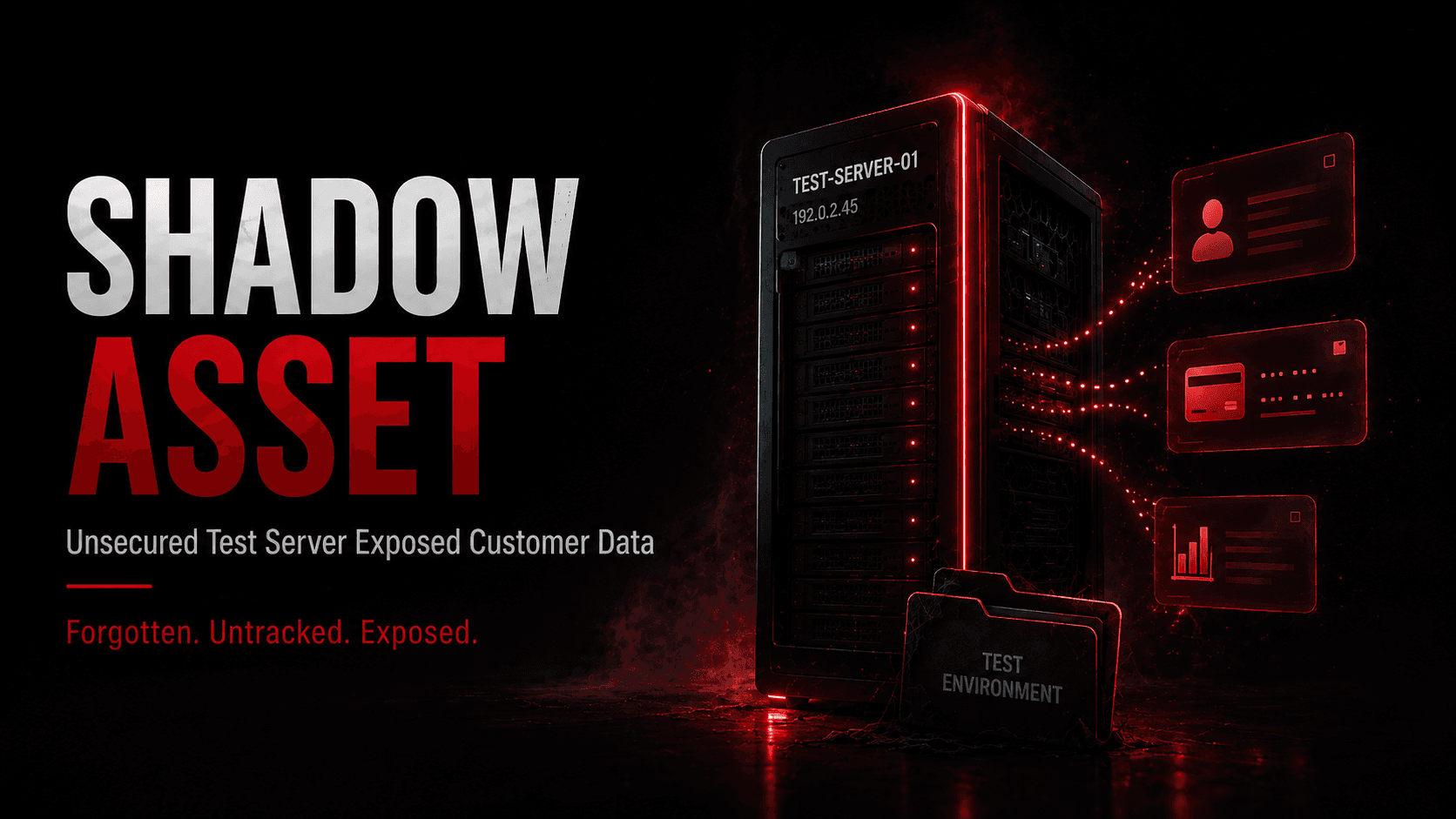
The server was never meant to be public. It simply existed, unlisted.
This is a case Orasec handled for a mid-sized fintech, where a forgotten test server exposed real customer data and could have led to a much larger incident.
What Is a Shadow Asset?
A shadow asset is a system, service, domain, cloud resource, or other digital asset that exists outside the organisation's approved or maintained inventory. External attack-surface tools specifically look for these unknown internet-facing assets. (Microsoft Learn)
Being untracked increases risk because the asset may fall outside normal patching, monitoring, vulnerability management, ownership, and decommissioning processes.
Shadow IT is the broader use or creation of technology outside normal governance. A shadow asset is one of the unmanaged systems or services that can result.
What Happened?
The company operated in a regulated environment and handled personal and financial data. Production was well covered: firewalls, encryption, access controls.
To test a new feature, a developer spun up a server that closely mirrored production. To save time, they populated it with a subset of real customer data.
Created outside the standard deployment process, it was never added to the asset inventory. The server was publicly reachable and lacked adequate authentication controls. Because nothing tracked it, nobody noticed.
How Was It Discovered?
Orasec's threat intelligence team found a post on an underground forum offering customer data linked to the company. The sample records matched real customers.
Correlating the leaked data against internal systems traced the source to the forgotten test server. A direct check confirmed it was live and returning customer data without proper authentication.
The evidence indicated that unauthorized parties had discovered the server before it was identified internally.
What Was Exposed?
The server held data from a recent onboarding test: customer names, email addresses, contact information, and partial financial and transaction details. A significant number of customer records.
Real data, not dummy records.
Why Does It Matter?
Available logs showed activity consistent with automated discovery or scanning rather than clear evidence of a highly targeted initial search. The evidence suggested that automated discovery exposed the host to subsequent unauthorized access.
That is what makes shadow assets dangerous. Production gets attention because everyone knows it is there.
Exposed records support fraud, identity theft, and targeted phishing, while the organisation faces regulatory penalties, legal exposure, and lost trust.
How Was It Contained?
The server was taken offline within hours and external access was cut.
Forensic analysis established how long it had been exposed and how it was likely found.
A wider review surfaced several smaller shadow assets, secured before anyone reached them.
Because the exposure was identified and contained, the organisation was able to limit further access and investigate the affected scope. Affected customers were notified, and the investigation found no evidence of widespread subsequent abuse at the time of review.
Common Mistakes
- Using real customer data in test environments. Convenience during development becomes the whole risk if the environment is exposed.
- Creating infrastructure outside the deployment process. Anything provisioned by hand skips inventory, monitoring, and patching together.
- Counting only production in the asset inventory. A list that excludes test and staging is not an inventory of what you expose.
- Treating discovery as an annual exercise. Attack surfaces change continuously as systems, subdomains, cloud resources, and integrations are added or removed. Point-in-time discovery can therefore miss exposures introduced between assessments. (Microsoft Learn)
- Having no decommissioning step. Temporary systems often persist longer than intended when ownership and decommissioning dates are not defined.
How to Reduce the Risk
- Require registration and approval before any asset becomes reachable
- Use synthetic or masked data in non-production environments
- Use continuous or frequent external attack-surface discovery alongside periodic penetration testing to identify newly exposed and unmanaged assets
- Apply production controls to test systems: authentication, patching, and logging
- Set expiry dates on temporary environments, with automatic shutdown
- Train developers on what shadow IT costs, not just what policy says
What Should Security Testing Cover?
Ask your testers to establish:
- What is externally reachable that no inventory records
- Whether non-production systems hold real customer data
- Whether any environment accepts unauthenticated access
- How long a newly exposed host goes unnoticed
How OraSec Can Help
Signal monitors darknet sources for data referencing your organisation, which is how this exposure surfaced. Alongside it, external penetration testing and Pentia's continuous testing and asset monitoring help identify reachable exposures before they are exploited. (OraSec)
Conclusion
No advanced attack. No insider. One forgotten server with real data on it, found by automation that was not looking for anyone in particular.
You cannot protect what you do not know exists. Visibility is not a reporting exercise; it is the control everything else depends on.
FAQs
What is a shadow asset? An asset that exists outside the organisation's maintained inventory or governance. As a result, it may miss normal patching, monitoring, testing, or decommissioning controls.
How are exposed assets found? Attackers and researchers use automated scanning, DNS data, certificate-transparency logs, search engines, and other internet-wide discovery techniques. (BleepingComputer)