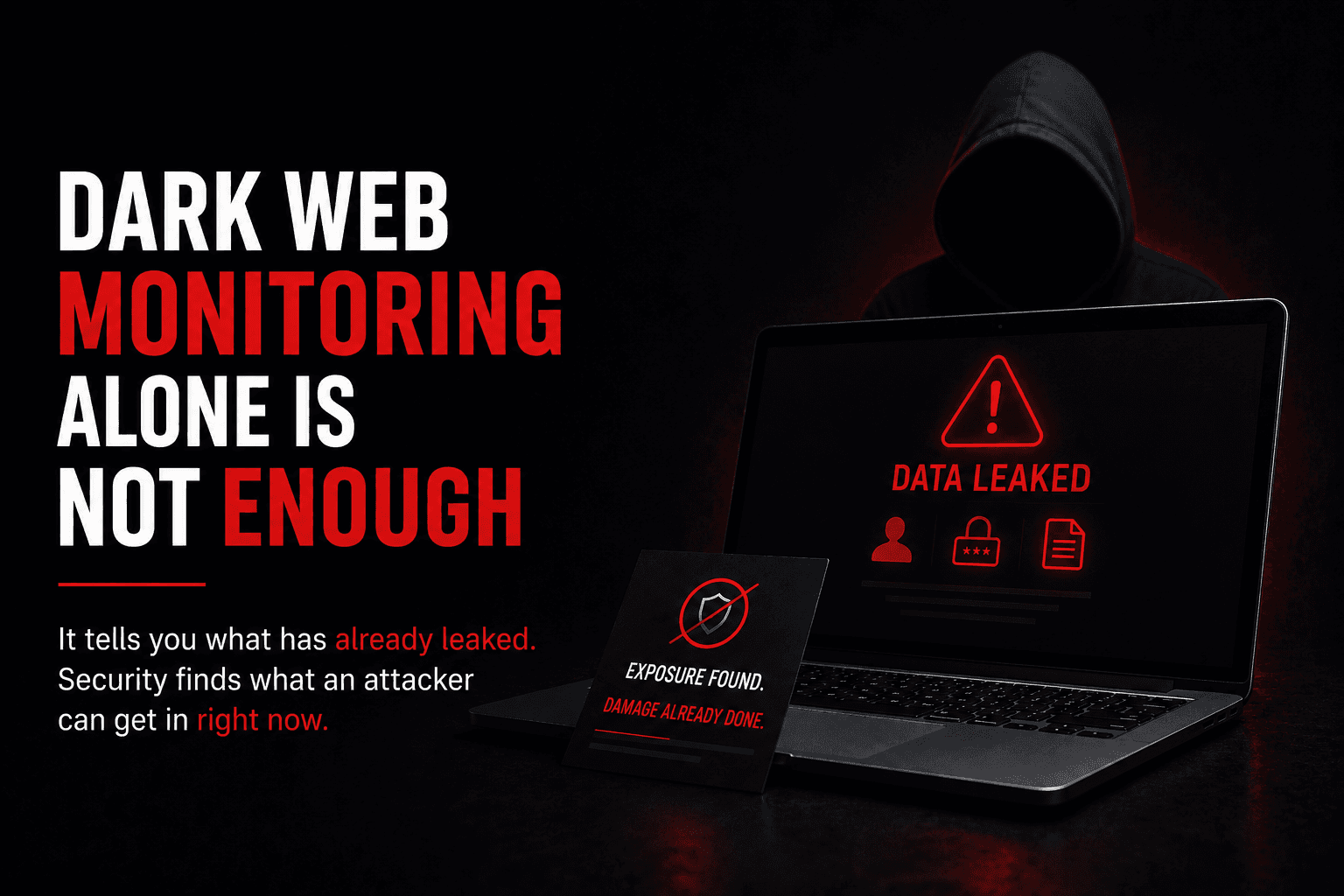
Dark web monitoring primarily tells you when credentials, data, or access related to your organisation have already surfaced outside your environment.
Security teams need an answer to a different one: can an attacker get in right now? Those are different questions. Dark web monitoring can sometimes provide early warning before stolen access is used, but proactive testing is designed to find weaknesses before they are exploited.
What Does Dark Web Monitoring Actually Do?
It scans underground forums, marketplaces, and paste sites for signs of your organisation: leaked credentials, email addresses, password hashes, access listings, domain mentions, and stolen data samples.
When something appears, you get an alert. That is useful. It confirms exposure, adds context to an investigation, and can trigger a response.
It is primarily a detective control. It reports exposure that has surfaced externally; it does not tell you everything happening inside your environment. CISA recommends credential monitoring as one layer alongside MFA, IAM, and other preventive controls. (CISA)
Why Does the Timing Work Against You?
A dark web alert may arrive after credentials or data have already been stolen, and in some cases after attackers have begun using that access.
A dark web listing can be evidence that exposure has already occurred, although some credential or access listings may be detected before attackers use them.
IBM's 2025 Cost of a Data Breach Report puts the global mean time to identify and contain a breach at 241 days, rising to 279 days in healthcare. (IBM)
What Does It Miss?
Data that never gets posted. Attackers may use stolen access themselves, advertise it publicly, or trade it privately. Private transactions may never appear in sources your monitoring provider can see.
Initial access sold quietly. Access brokers are a distinct part of the criminal economy: they compromise an organisation, then sell entry to whoever wants it. Initial access may be sold through public forums, private marketplaces, or closed channels. Monitoring may catch advertised access, but private sales and direct broker relationships can remain invisible. Microsoft documents brokers selling compromised RDP and other privileged access to ransomware operators. (Microsoft)
Context. An alert tells you a password leaked. It does not say which system was compromised, whether access is still active, or what else was touched. Without internal visibility, response starts with guesswork.
Why Does It Matter?
The real risk is the confidence it creates.
Once monitoring is in place, teams assume they would know if something leaked. That makes it easier to defer security improvements, leave misconfigurations open, and treat testing as an annual formality.
Monitoring can become false reassurance if teams treat it as proof that no exposure exists.
Common Mistakes
- Treating it as an early warning system. It reports exposure that has already happened.
- Assuming silence means safety. Private trades produce no alerts.
- Expecting alerts to explain themselves. A listing rarely identifies the source.
- Letting it substitute for testing. Knowing data leaked is not knowing how.
- Running it without a response plan. An alert nobody acts on changes nothing.
What Should Sit Alongside It?
- Continuous attack surface discovery across APIs, admin panels, cloud services, forgotten hosts, and shadow assets
- Phishing-resistant MFA and credential hygiene, so stolen credentials are worth less
- Removal of stale accounts and regular review of standing access
- Internal logging and detection, which tells you during an intrusion, not after
- Regular security testing that finds attacker paths before they are used
If stolen credentials do not work, they are worth less to sell.
What Should Security Testing Cover?
Ask your testers to establish:
- What is exposed externally that nobody has inventoried
- Whether leaked credentials still grant access anywhere
- Which internal systems one compromised account can reach
- Whether an intrusion would generate an alert someone acts on
- How long simulated attacker activity runs before a response
How OraSec Can Help
OraSec runs darknet monitoring through Signal, but treats it as one input rather than the answer. Alongside it, Pentia provides continuous penetration testing, and our threat hunting and red team work look for the access that never reaches a marketplace.
The aim is to find exposure before anyone monetises it, so an alert becomes confirmation rather than the first you hear of it.
Conclusion
Dark web monitoring is worth having. It gives visibility into exposure you would otherwise hear about from a customer, a regulator, or a ransom note.
It is not a preventive control by itself. It provides useful external exposure intelligence, while prevention and early detection require controls inside and around your environment.
FAQs
Is dark web monitoring worth the cost? As one layer, yes. It provides exposure visibility that is hard to obtain otherwise. As a primary control, it does not prevent attacks.
How quickly do leaked credentials appear on the dark web? It varies, and some never appear. Credentials may be used or privately sold long before, or instead of, any public listing.
Does an alert mean we have been breached? Not necessarily. Credentials can leak from third-party breaches where staff reused passwords. The alert marks exposure; investigation establishes the source.
What should we do when an alert arrives? Reset the affected credentials, revoke active sessions and tokens, check the relevant logs for unauthorised access, and identify where the exposure originated.
What can complement dark web monitoring? Internal detection can identify suspicious activity during an intrusion, while security testing can expose attack paths before they are used.