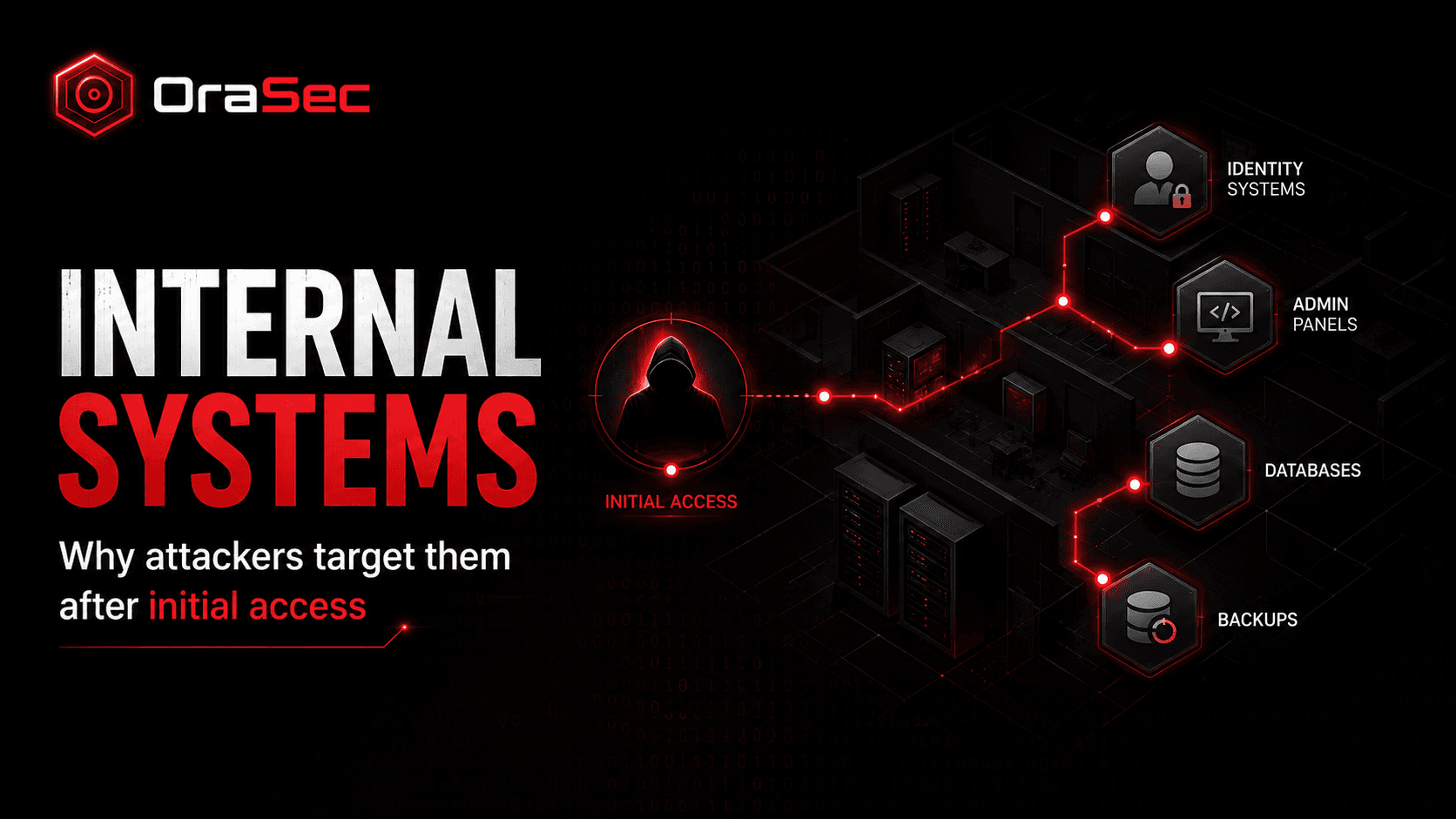
Getting in is not the win. It is the setup.
An attacker holding one compromised account has a foothold, not control. What turns that foothold into a breach happens next, and it happens inside.
What Is Initial Access?
Initial access is the first foothold an attacker gains inside a network. It can come from stolen credentials, an exposed VPN, a cloud misconfiguration, a leaked API key, a phishing email, or a flawed external app.
It rarely means full control. At that stage an attacker usually holds limited rights on a single system through one compromised account.
The value is in what that position can reach.
Why Do Internal Systems Come Next?
External-facing systems often receive more security attention because they are directly exposed. After gaining access, attackers may shift focus to internal systems that provide better access to identities, data, and privileged services.
Internal systems are often different. Many were built on the assumption that anything already inside the network is trusted. That assumption shows up as weaker authentication, broader access rights, and lighter monitoring.
What Do Attackers Target Internally?
Identity systems are high-value targets because access to Active Directory, IAM, SSO, or privileged accounts can make later movement easier.
Internal admin panels can become high-value targets when access depends too heavily on network location or weak authentication.
Databases and internal APIs. Services that trust callers by network position rather than checked identity. Test databases holding real data are a recurring find.
Backup systems are high-value targets during ransomware operations because attackers may try to delete or encrypt backups before causing wider impact. CISA specifically recommends offline and immutable backups for this reason. (CISA)
Why Does It Matter?
Initial access gives an attacker a foothold. The impact can grow when they escalate privileges, steal credentials, move laterally, collect data, or disrupt systems.
Activity using valid credentials and native administrative tools can blend into legitimate behaviour and may be harder to detect. MITRE notes that attackers can use legitimate credentials and built-in tools for stealthier lateral movement. (MITRE ATT&CK)
Common Attack Pattern
A common escalation pattern in incident reports:
- Initial access through a small exposure
- Movement toward identity or admin systems
- Privilege escalation using reused or cached credentials
- Broad access established before anything alerts
- Detection after data loss, encryption, or a ransom demand
The perimeter was only the first barrier. The larger problem was how far the attacker could move after gaining a foothold.
Common Mistakes
- Monitoring outward only. Perimeter alerting says nothing about movement between internal hosts.
- Treating network position as identity. Being inside the network is not authentication.
- Leaving internal logging incomplete. Activity nobody records cannot be investigated later.
- Testing external systems only. Internal privilege and lateral-movement paths may remain untested even though they can become important after compromise.
- Assuming the asset list is complete. Forgotten systems often hold weaker controls.
How to Reduce the Risk
- Require authentication for internal services, not just external ones
- Apply least privilege and review standing access on a set schedule
- Segment networks so one compromised host cannot reach everything
- Alert on privilege changes, new admin accounts, and service account misuse
- Protect and isolate backups so they survive a compromise of the primary environment
- Log internal logins and access centrally, with enough context to spot probing
- Keep an asset list that includes internal tools and test environments
Assume perimeter controls may eventually fail and design internal controls to limit what happens next.
What Should Security Testing Cover?
Ask your testers to establish:
- What one set of stolen credentials actually reaches
- Which internal services can be accessed without authentication
- Whether privilege escalation paths exist from a standard user account
- Which trust relationships between systems can be abused
- Whether internal movement generates any alert a person would see
How OraSec Can Help
OraSec tests what happens after an attacker gets in, not just whether they can. We map internal attack paths, attempt real lateral movement, surface hidden trust relationships, and measure the blast radius of a single compromised account. You get a demonstrated path, not a list of theoretical risks.
Conclusion
Initial access is the entry point. Internal systems decide how bad it gets.
Assume the perimeter will be crossed at some point. Then ask a harder question: if an attacker held one valid account inside your network today, how far could they get, and would anyone notice?
FAQs
Is this only a large enterprise problem? No. Smaller environments often have flatter networks and less internal monitoring, which can make lateral movement easier once an attacker is inside.
Does Zero Trust solve this? It addresses the root assumption by removing implicit trust based on network location. It is an architecture to work toward, not a product that closes the gap on install.
How quickly do attackers move internally? It varies widely. Some move within hours, while others stay quiet for weeks to avoid detection. Planning for either is safer than assuming one.
Can EDR detect lateral movement? Sometimes, through credential use and process behaviour. Detection is harder when attackers use valid credentials and built-in administrative tools.
Where should we start? Network segmentation and internal logging. Segmentation limits how far an attacker reaches, and logging determines whether you can see it happen.