Cybersecurity threats are increasing in complexity, and organizations are under constant pressure to secure their digital assets. Penetration testing helps identify vulnerabilities before attackers exploit them in real scenarios. However, the effectiveness of testing depends heavily on the provider you choose. Many businesses struggle to differentiate between basic vendors and skilled security teams. This makes the selection process critical for long-term security posture. Choosing the right provider ensures accurate risk identification and meaningful security improvements.
What is a Penetration Testing Provider?
A penetration testing provider is a cybersecurity company that simulates real-world attacks to identify security weaknesses in systems, applications, and networks. They use both manual techniques and security tools to uncover vulnerabilities that attackers could exploit. Their goal is to replicate attacker behavior in a controlled and safe environment. Providers also assess how deep an attacker could move within a compromised system. After testing, they deliver structured reports with findings and remediation guidance. This helps organizations clearly understand and fix their security gaps.
Why Choosing the Right Penetration Testing Company Matters
The quality of a penetration test is directly influenced by the expertise and approach of the provider. Low-quality vendors often rely heavily on automated tools and miss critical vulnerabilities, especially logic-based issues. This can lead to incomplete assessments and a false sense of security. A strong provider focuses on manual testing and real-world attack simulation. They help organizations understand actual risk impact instead of just listing technical issues. This ensures security decisions are accurate and business-focused.
You May Also Like: How to Prepare Your Organization for a Pentest
How to Choose the Right Penetration Testing Provider
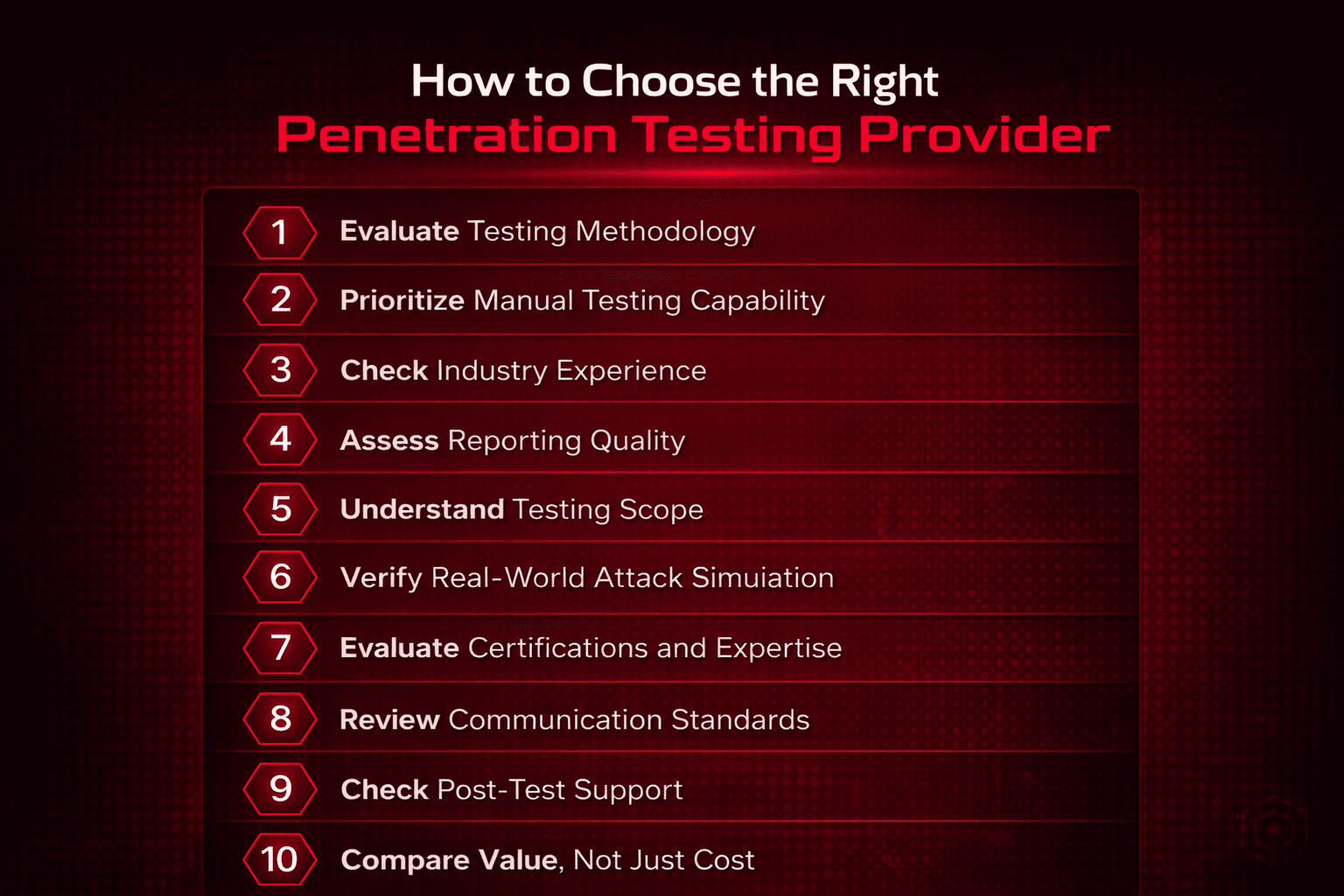
1. Evaluate Testing Methodology
A professional provider follows structured methodologies such as OWASP, NIST, or PTES to ensure complete and consistent coverage. This ensures testing is not random or tool-driven. A clear methodology also helps organizations understand how the assessment is performed. Without it, results may lack depth and reliability.
2. Prioritize Manual Testing Capability
Manual testing is essential for identifying vulnerabilities that automated tools cannot detect, especially logic flaws and complex attack chains. A strong provider clearly defines how much manual effort is included in their process. Over-reliance on automation often leads to missed critical risks. Manual expertise significantly improves testing accuracy.
3. Check Industry Experience
Different industries face different threat models, compliance requirements, and attack patterns. A provider with relevant industry experience understands these risks more effectively. This leads to more realistic and meaningful findings. Industry knowledge improves overall testing quality and relevance.
4. Assess Reporting Quality
A penetration testing report should be structured, clear, and actionable for both technical and non-technical teams. It must include risk severity, exploitation details, and remediation guidance. Weak reporting reduces the value of the entire engagement. Strong reporting directly improves remediation speed.
Check This Guide: Penetration Testing vs Vulnerability Assessment
5. Understand Testing Scope
The testing scope defines exactly what systems, APIs, or applications will be assessed during the engagement. A vague scope can leave critical assets untested and expose security gaps. A well-defined scope ensures complete visibility of risk areas. Clear scoping is essential for meaningful results.
6. Verify Real-World Attack Simulation
A strong provider should simulate actual attacker behavior rather than just running automated scans. This includes exploiting vulnerabilities and chaining attack paths for deeper access. Real-world simulation provides a realistic view of security exposure. It reflects how real attackers operate.
7. Evaluate Certifications and Expertise
Certifications such as OSCP or similar validate technical capability and hands-on experience. However, real-world testing experience is equally important for accuracy. A balanced team combines both theoretical knowledge and practical skill. This improves the quality of findings.
8. Review Communication Standards
Clear and consistent communication is essential throughout the testing lifecycle. Providers should explain findings in simple, actionable language for all stakeholders. Poor communication can delay remediation efforts. Strong communication improves security outcomes significantly.
9. Check Post-Test Support
Security testing should not end with a report delivery. A good provider offers remediation guidance and re-testing support. This ensures vulnerabilities are properly fixed and validated. Post-test support adds long-term value to the engagement.
10. Compare Value, Not Just Cost
Low-cost providers often compromise on depth, manual effort, or expertise. High-quality penetration testing requires time, skill, and structured analysis. Organizations should focus on value and quality instead of price alone. Better investment leads to stronger security outcomes.
Also Read: PTaaS vs Traditional Pentesting: What's the Difference
Comparing Penetration Testing Providers Effectively
Helpful Guide: Top Vulnerability Management Tools
Red Flags When Choosing a Penetration Testing Vendor
1. Heavy Reliance on Automated Tools
If a provider depends only on automated scanners, it indicates shallow testing depth. Automated tools cannot identify complex logic or chained vulnerabilities. This leads to incomplete security assessments. Manual testing is essential for real coverage.
2. Vague or Generic Reporting
Reports that lack technical depth or actionable guidance are a major warning sign. They fail to help teams understand or fix vulnerabilities effectively. Good reports must clearly explain impact and remediation. Weak reporting reduces overall value.
3. No Defined Testing Methodology
A lack of structured methodology shows poor testing discipline and inconsistency. It often results in missed vulnerabilities and unreliable findings. Professional providers always follow recognized frameworks. Methodology ensures trust and completeness.
4. No Real-World Exploitation Testing
If a provider only identifies vulnerabilities without demonstrating exploitation, the assessment is incomplete. Real attack simulation is critical for understanding actual risk impact. Without it, severity can be underestimated. This is a major red flag.
5. No Post-Test Support or Validation
If the provider does not assist after testing, vulnerabilities may remain unpatched or unverified. Proper security testing includes remediation guidance and re-validation. Lack of support reduces long-term effectiveness. Strong providers ensure issues are fully resolved.
How Orasec Strengthens Your Security
Orasec delivers advanced penetration testing services designed to uncover deep security vulnerabilities across applications, APIs, and infrastructure. The approach combines manual expertise with structured methodologies to simulate real-world attack scenarios. This ensures organizations understand not only what is vulnerable but how it can be exploited. Detailed reporting helps teams prioritize fixes effectively. The focus is on delivering actionable security insights. This strengthens long-term defense against evolving cyber threats.
Conclusion
Choosing the right penetration testing provider is a critical decision for any organization. It directly impacts how effectively vulnerabilities are identified and resolved. A strong provider brings structured methodology, manual expertise, and real-world attack simulation. This ensures accurate and meaningful security insights. Poor selection can lead to missed risks and false confidence. The right partner strengthens long-term cybersecurity resilience.
FAQs
What should I look for in a penetration testing provider?
Look for methodology, manual testing capability, experience, reporting quality, and post-test support.
Is automated testing enough?
No, automated testing alone cannot detect complex vulnerabilities like logic flaws.
How often should penetration testing be done?
At least once a year or after major system changes.
What is the difference between scanning and penetration testing?
Scanning identifies known issues, while penetration testing simulates real attacks.
Why is reporting important?
Because it helps teams understand risks and fix vulnerabilities effectively