SQL injection has been on the OWASP Top 10 for over a decade. Despite being well understood and relatively straightforward to prevent, it remains one of the most exploited vulnerability classes in the wild. Attackers use it to extract sensitive data, bypass authentication, escalate privileges, and in some cases take full control of backend servers. Understanding how SQL injection works — and how to prevent it — is non-negotiable for any team building or operating web applications.
What Is SQL Injection?
SQL injection occurs when an application includes user-supplied input in a database query without properly sanitising or parameterising it. The database interprets the input as part of the query logic rather than as data. The result is that an attacker can manipulate the query to return data it shouldn't, modify records, delete tables, or execute operating system commands depending on the database configuration. The root cause is always the same: treating untrusted input as trusted query structure. This is a design failure, not a configuration mistake, which is why it persists across languages, frameworks, and tech stacks.
Also Read: Microsoft SQL Server 0-Day Vulnerability
Types of SQL Injection
In-Band (Classic) SQL Injection
In-band SQL injection is the most straightforward type. The attacker sends a malicious payload and the results are returned directly in the application's HTTP response. There are two sub-types: error-based, where the attacker reads database information from error messages the application exposes, and union-based, where the attacker appends a UNION SELECT statement to extract data from additional tables. In-band attacks are fast and easy to confirm, making them a primary target during penetration tests.
Blind Boolean-Based SQL Injection
In blind boolean-based injection, the application doesn't return query results or error messages directly. Instead, the attacker infers data by asking true/false questions through crafted payloads. If the query is true, the application behaves one way. If it's false, it behaves differently. By chaining these binary responses, attackers can extract entire database schemas and table contents — one bit at a time. It's slower than in-band injection but just as dangerous.
Helpful for you: MongoDB Security Common Risks
Blind Time-Based SQL Injection
Time-based blind injection works similarly, but the signal is response time rather than a behavioural difference. The attacker injects a conditional delay command — such as SLEEP() in MySQL or WAITFOR DELAY in SQL Server. If the application takes longer to respond when a condition is true, the attacker can extract data using the same binary inference approach. This technique works even when the application returns identical responses regardless of query outcome.
Out-of-Band SQL Injection
Out-of-band injection is less common but used when in-band and blind techniques aren't reliable. Instead of using the HTTP response channel, the attacker causes the database to make an external network connection — typically a DNS lookup or HTTP request to an attacker-controlled server. This requires specific database features and network configurations, but when it works, it bypasses many monitoring controls focused solely on HTTP traffic.
Must Read: How Can HTTP Status Codes Tip Off a Hacker?
How SQL Injection Attacks Work in Practice
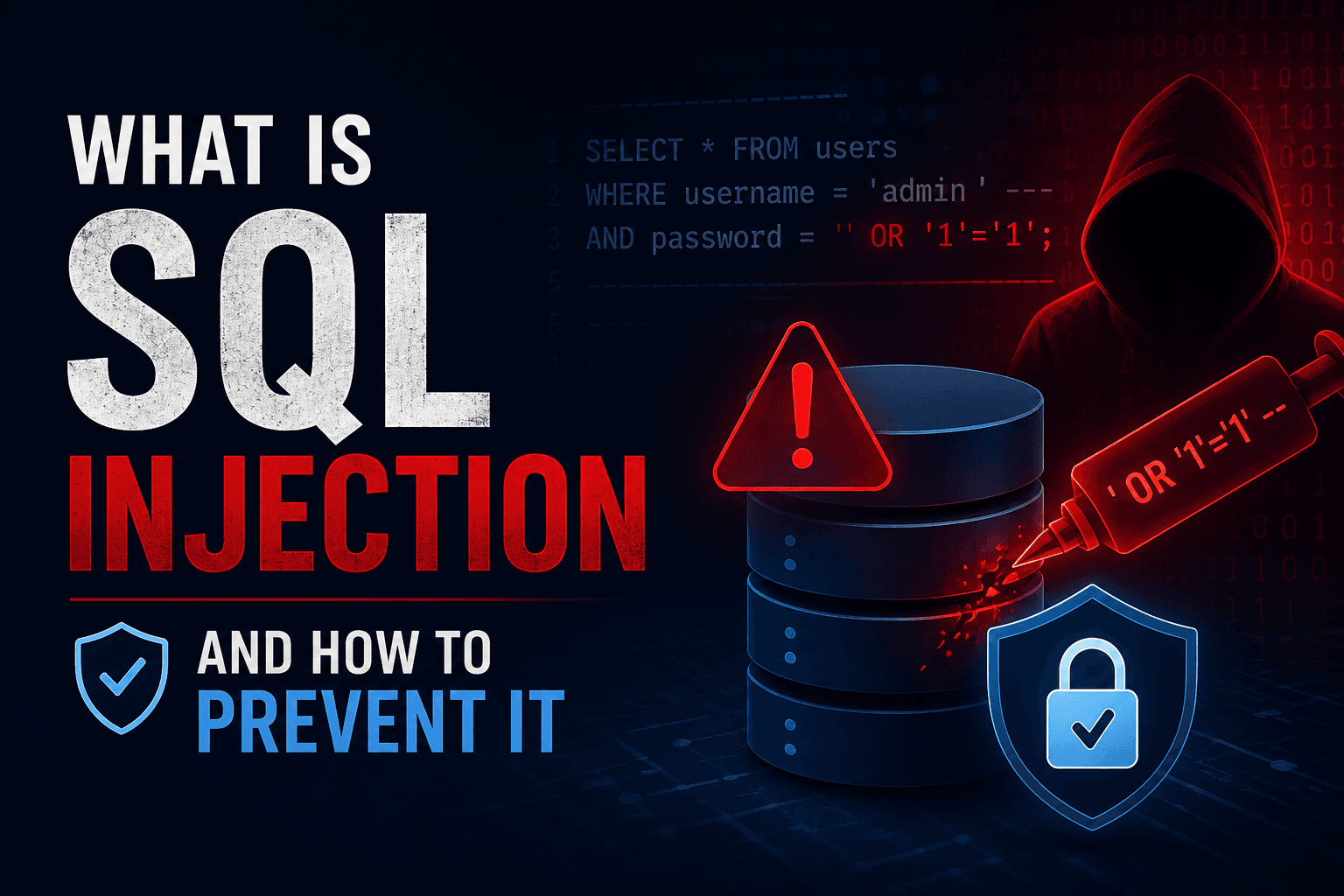
Consider a login form that constructs a query like: SELECT * FROM users WHERE username = '[input]' AND password = '[input]'. An attacker who enters ' OR '1'='1 as the username turns the query into one that returns all users because the condition is always true. This bypasses authentication entirely without knowing any valid credentials.
More sophisticated attacks go further. An attacker who identifies a union-based injection point can map the entire database schema, extract user tables, password hashes, payment records, and session tokens. In databases with stacked query support, attackers can write files to disk or execute operating system commands. The progression from finding a single injection point to full server compromise is well-documented in real-world breaches.
Real-World Impact of SQL Injection
SQL injection attacks have been responsible for some of the largest data breaches in history. Card data, health records, government databases, and financial systems have all been compromised through injection vulnerabilities. The impact isn't limited to data theft. Attackers use SQL injection to delete records, manipulate transactions, create backdoor admin accounts, and establish persistence inside networks. GDPR fines and PCI DSS penalties for preventable injection vulnerabilities have been substantial.
Prevention Methods for SQL Injection
Parameterised Queries and Prepared Statements
Parameterised queries are the most reliable defence against SQL injection. They separate query structure from user input at the API level, making it structurally impossible for input to alter query logic. Every major programming language and database driver supports parameterised queries. There is no performance trade-off. Any codebase that constructs SQL queries through string concatenation or interpolation should be treated as vulnerable until it is refactored.
Input Validation
Input validation reduces attack surface but should not be the primary defence. Validating that an email address looks like an email address or that a numeric ID is actually numeric removes a large class of simple payloads. However, validation can be bypassed, particularly in applications that accept complex or freeform input. Use it alongside parameterised queries, not instead of them.
You May Also Like: Breach Attack Simulation vs Red Teaming
Least Privilege Database Accounts
Application database accounts should only have the permissions they need. A web application that reads and writes user records does not need DROP TABLE privileges. A reporting service that only reads data should use a read-only account. Least privilege doesn't prevent injection, but it dramatically limits what an attacker can do if they find one. Lateral movement from application database to full server access often depends on overprivileged database accounts.
Web Application Firewalls
WAFs can detect and block common SQL injection payloads at the network layer. They provide a useful additional layer of defence, particularly against automated scanners and commodity attack tools. However, WAFs should not be relied on as the primary control. Skilled attackers regularly bypass WAF rules through obfuscation, encoding variations, and less common injection techniques. A WAF that creates false confidence in an application with unparameterised queries is dangerous.
Error Message Hardening
Detailed database error messages returned to users are a significant aid to attackers conducting error-based injection. Stack traces and query errors that leak table names, column names, or query structure should never be visible in production responses. Implement generic error pages for database failures, and log detailed errors server-side for debugging purposes only. Information leakage through error messages often turns a blind injection into a much faster in-band attack.
How Orasec Can Help
Orasec's web application penetration testing covers SQL injection and the full OWASP Top 10 across your web and API attack surface. Our testers go beyond automated scanning to manually verify exploitability, map injection points to business impact, and provide specific, actionable remediation guidance.
Conclusion
SQL injection is old, well-understood, and entirely preventable. Yet it continues to appear in penetration test reports and breach disclosures every year. Parameterised queries, least privilege database accounts, and proper error handling eliminate the vast majority of injection risk. If your applications still construct SQL through string concatenation, fixing that should be the highest-priority item on your security backlog.
FAQs
What is SQL injection in simple terms?
SQL injection is a security vulnerability where attackers inject malicious input into database queries to access or modify data they shouldn’t.
Why is SQL injection still a major threat today?
It still exists because many applications fail to use secure coding practices and rely on unsafe query construction methods.
What are the main types of SQL injection?
The main types include in-band SQL injection, blind boolean-based injection, blind time-based injection, and out-of-band SQL injection.
How does blind SQL injection work?
Blind SQL injection extracts data by observing changes in application behavior or response time instead of direct output.
What is the best way to prevent SQL injection?
The most effective prevention method is using parameterised queries or prepared statements to separate data from SQL logic.
Can a Web Application Firewall (WAF) stop SQL injection?
A WAF can block common attacks, but it should only be considered a secondary layer of defence, not the main solution.
What damage can SQL injection cause?
It can lead to data theft, authentication bypass, data deletion, privilege escalation, and full system compromise.
Does input validation alone prevent SQL injection?
No. Input validation helps reduce risk but cannot fully prevent SQL injection without secure query handling.
Why are error messages dangerous in SQL injection attacks?
Detailed error messages can reveal database structure and help attackers craft more effective exploits.
Who is responsible for preventing SQL injection in an application?
Developers and security teams are responsible for implementing secure coding practices and proper database security controls.