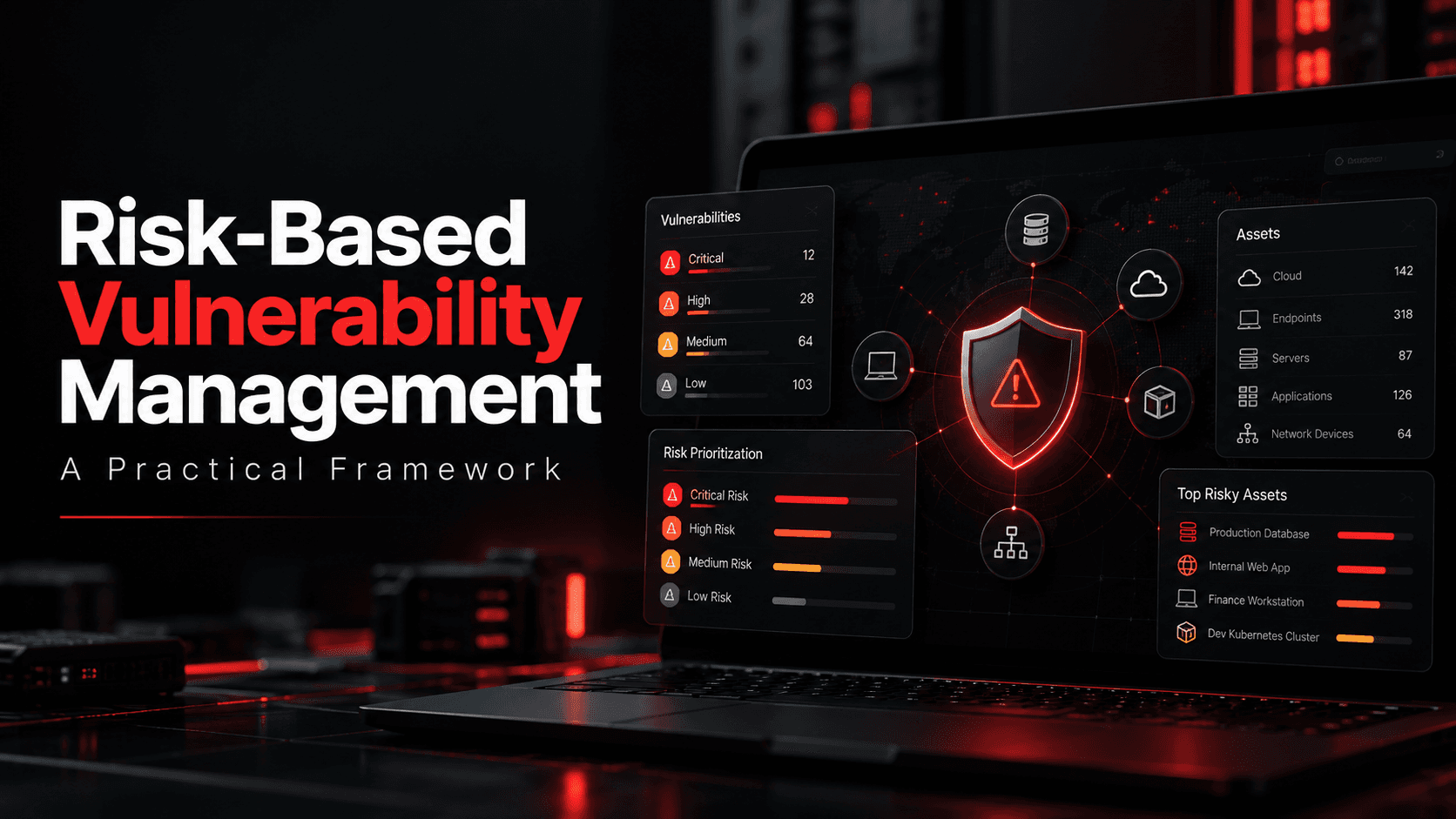
Risk-based vulnerability management (RBVM) decides what to fix first by asking how likely a flaw is to be used against you and what it would cost if it were. It weighs threat activity, exposure, and business impact instead of severity scores alone. Scanner findings are often not what gets an attacker in. In one Active Directory takeover, no zero-days or missing patches were exploited: a rogue Wi-Fi network, a cracked password, and a certificate template misconfiguration were enough.
What is risk-based vulnerability management?
A way to decide which flaws to fix first, based on exploitation, exposure, and business impact, not severity alone.
What are the 5 steps of vulnerability management?
Discover assets and flaws, prioritize them by risk, remediate, verify each fix, then report and improve the process.
What are the four stages of vulnerability management?
Many models use four: identify, evaluate, treat, and report. The cycle repeats as new assets and flaws appear.
Is NIST 800-53 a risk management framework?
Not on its own. SP 800-53 is a control catalog. The Risk Management Framework itself is NIST SP 800-37.
What are the four main types of vulnerability?
There's no universal four-type classification. Common categories include network, application, operating system, and human or process weaknesses.
Key Takeaways
- CVSS shows how bad a flaw could be. RBVM adds whether it's exploited, reachable, and what sits behind it.
- You can't rank risk on assets you don't know about.
- CISA's KEV catalog and EPSS are useful free signals, but neither is complete.
- An exploited flaw on an internet-facing system needs fixing in days, whatever its score.
- A closed ticket isn't a fix. Verify high-risk remediation with a rescan or retest.
- Measure how fast real exposure falls, not how many tickets close.
What Is Risk-Based Vulnerability Management?
RBVM doesn't replace scanning. It changes what happens after the scan. Each finding gets context a scanner can't see: what the asset does, who can reach it, what data it holds, and whether attackers are using the flaw now. Findings are then ranked by risk and assigned to owners.
Take two findings. One is a critical-rated flaw on an isolated build server with no sensitive data. The other is a medium-rated flaw on your VPN gateway that's listed as actively exploited. A severity-sorted report puts the first on top. RBVM ranks the second higher.
RBVM also covers misconfigurations, exposed admin panels, weak credentials, and cloud permission mistakes, which often become serious findings in penetration tests. This is where vulnerability work overlaps with wider risk management.
Why Traditional Vulnerability Management Falls Short
Traditional programs were built for fewer servers, fewer flaws, and slower attackers. That no longer holds.
- There are too many vulnerabilities to fix them all. More than 40,000 CVEs were published in 2024, a record at the time. Few teams can fix everything, so the question is which findings stay open.
- Severity is not risk. FIRST, which maintains CVSS, stresses in version 4.0 that CVSS is more than the base score, which lacks threat and environmental context.
- Attackers move faster than patch cycles. JFrog patched an Artifactory authentication bypass on August 28, 2026, and it was exploited within days of the patch. The 2026 Verizon Data Breach Investigations Report found 31% of breaches started with vulnerability exploitation.
- Scanners miss what attackers chain together. In the Active Directory takeover above, each weakness looked minor on its own. Business logic flaws are also hard for scanners to catch: in one hotel booking audit, a missing authorization check on a loyalty API could have exposed data for 2.7 million people, found only by changing one ID in a request.
- Ticket counts hide real exposure. Closing 5,000 low-risk findings looks good while one exploited flaw on your gateway stays open.
How Risk-Based Vulnerability Management Works
RBVM runs as a cycle, not a quarterly scan-and-report exercise.
1. Identify Assets and Business Criticality
Inventory everything you run: servers, endpoints, cloud accounts, containers, SaaS platforms, and internet-facing services. Pull from several sources, such as cloud APIs, agents, and attack surface discovery, because each can miss something. Then rate each asset's criticality: does it hold customer or payment data, support a revenue-critical service, or sit next to a domain controller? Three or four levels are enough. Missed assets can matter most. In one fintech case, OraSec's threat intelligence team found customer data offered on an underground forum; it traced back to a publicly reachable test server, loaded with real data, that was never added to the inventory.
2. Discover and Validate Vulnerabilities
Bring findings from scans, agents, cloud posture tools, code and container scanning, and penetration test reports into one place, and remove duplicates. Then validate what matters: is the vulnerable package loaded? Is the port reachable from where an attacker would stand? False positives erode trust in the list, which is where penetration testing and vulnerability scanning differ most.
3. Assess Exploitability and Threat Activity
Check what attackers are doing with each finding now, using public sources and threat intelligence: whether it's in CISA's Known Exploited Vulnerabilities (KEV) catalog (which also flags known ransomware use); its EPSS score, the estimated probability of exploitation in the next 30 days; and whether public exploit code or a working proof of concept exists. Don't wait for KEV to confirm what you can already see. Exploitation of the JFrog flaw was publicly reported before CISA added it.
4. Measure Exposure and Business Impact
Exposure is about reach. A flaw on an internet-facing login page is open to anyone; the same flaw on a server reachable only from one admin subnet needs an attacker who's already inside. Impact is about what sits behind the asset: data sensitivity, regulatory exposure, downtime cost, and onward access. In one published case, an S3 bucket holding internal database backups was accidentally made public. No CVE was involved, yet it nearly triggered a $5M GDPR fine.
5. Prioritize Vulnerabilities by Risk
Combine the signals into one decision, with a weighted score or a decision tree such as CISA's Stakeholder-Specific Vulnerability Categorization (SSVC), which ends in one of four outcomes: Track, Track*, Attend, or Act. Write the rules down, so anyone can see why a medium sits above a critical: it's exploited, internet-facing, and guards customer data.
6. Remediate the Highest-Risk Issues
Send each finding to the asset owner's ticketing tool with a deadline set by its risk tier. Only remediation removes the weakness, so track mitigated and accepted risks separately, because mitigation and remediation aren't the same. Remediate by patching, upgrading, or fixing the configuration. Mitigate, if a fix isn't possible yet, with segmentation, access restrictions, a WAF rule, or monitoring. Accept, by recording the decision, reason, owner, and review date.
7. Validate Fixes and Reassess Risk
Confirm each high-risk fix with a rescan or retest before closing the ticket. Patches fail, and configurations get rolled back. Then reassess: new exploits appear, EPSS scores change, and assets change role.
Helpful for you: What Happens After a Penetration Test Ends
Key Factors Used to Prioritize Vulnerabilities
No single factor is enough.
- Active exploitation: listed in KEV, reported in threat intelligence, or seen in your logs.
- Exploit probability: the EPSS score.
- Exploit availability: public code or a weaponized module.
- Exposure: internet-facing, reachable from partner or user networks, or admin-only.
- Asset criticality: how important the system is.
- Data sensitivity: personal, payment, health, or confidential data.
- What the attacker gains: code execution or admin rights versus a minor leak.
- Attack path value: whether it leads to a jump host, CI/CD runner, or domain admin sessions.
- Compensating controls: MFA, segmentation, or a WAF rule that blocks the attack.
- Severity: CVSS, as a starting point, not the final word.
Related: Vulnerability Prioritization: Beat Patching Paralysis
Risk-Based Vulnerability Management Framework
Each stage feeds the next, and the last loops back to the first.
Stage | Question it answers | Main inputs | Output |
|---|---|---|---|
1. Assets and criticality | What do we have, and what matters most? | Cloud APIs, agents, CMDB, external attack surface discovery, business owners | Inventory with a criticality rating for each asset |
2. Discover and validate | What is wrong, and is it real? | Scanners, cloud posture tools, code and container scans, pentest reports | One deduplicated, validated list of findings |
3. Exploitability | Are attackers using it, or likely to? | CISA KEV, EPSS, exploit databases, threat intelligence | Threat context for each finding |
4. Exposure and impact | Can an attacker reach it, and what would they get? | Network paths, access controls, data classification | Exposure and impact rating |
5. Prioritize | What do we fix first? | All of the above, plus written scoring rules or SSVC | Ranked list with a risk tier and a deadline |
6. Remediate | Who fixes it, and how? | Asset owners, ticketing tools, change windows | Fix, mitigation, or recorded risk acceptance |
7. Validate and reassess | Did it work, and has anything changed? | Rescans, retests, updated threat data | Verified closure and updated priorities |
Risk tiers turn the ranking into deadlines. These are a starting point, not a standard.
Tier | Typical trigger | Starting deadline |
|---|---|---|
Act | Known to be exploited and reachable by an attacker, on an important asset | 72 hours, with a mitigation sooner if no patch exists |
High | Public exploit or high EPSS score, on an exposed or critical asset | 14 days |
Medium | No known exploitation, internal reach only, moderate impact | Next scheduled patch cycle, usually 30 to 60 days |
Low | Hard to reach, low impact, or blocked by existing controls | Normal maintenance, or accept with a review date |
Common RBVM Challenges
- Gaps in the inventory. Cloud resources, shadow IT, test and staging systems, and acquired networks often sit outside the scanner's view.
- No business context. Without input from system owners, criticality ratings become guesses.
- Too much noise. Duplicates, false positives, and retired systems bury real issues until engineers ignore the list.
- Unclear ownership. Security finds the problem, but another team has to fix it. Findings with no named owner tend to stall.
- Systems you can't patch. End-of-life software, OT and medical devices, and vendor appliances may never get a fix. They need compensating controls and a recorded decision.
- Trusting the score too much. Risk scores can't see business logic flaws, chained misconfigurations, or credentials left in a script. That's the gap between a vulnerability assessment and a penetration test.
Risk-Based Vulnerability Management Best Practices
- Build the inventory from several sources, and review it continuously.
- Agree criticality with the business, and revisit it when systems change role.
- Use more than one signal: CVSS, KEV, EPSS, exploit availability, and exposure.
- Write down your scoring rules. They also give auditors evidence for frameworks such as PCI DSS, ISO 27001, and SOC 2.
- Set deadlines by risk tier. Exploited, exposed flaws get days.
- Give every finding an owner, routed through the tools the team already uses.
- Treat misconfigurations as vulnerabilities, in the same queue as missing patches.
- Test your priorities with real attacks. A penetration test can show that a "medium" is the first step to your most sensitive data.
- Verify before you close. Confirm each fix through a rescan, retest, configuration check, or other reliable evidence.
How to Measure RBVM Effectiveness
Good metrics show whether real exposure is going down.
- Mean time to remediate by risk tier: how long Act and High findings stay open.
- Open known-exploited vulnerabilities: KEV-listed flaws on exposed assets, and their age. The target is zero.
- Deadline compliance: the percentage fixed within their tier's deadline.
- Asset coverage: the share of known and critical assets scanned on schedule.
- Exposure window: time from disclosure or exploit release to your fix.
- Risk trend: total open risk, weighted by tier, month by month.
- Reopen rate: fixed findings that return in a later scan or retest.
- Risk acceptance age: accepted risks past their review date.
Avoid leading with "vulnerabilities closed." It rewards easy fixes and says little about breach likelihood.
How OraSec Can Help
RBVM shows which findings look most dangerous. Our vulnerability assessment and penetration testing shows which ones an attacker can actually use and chain. Findings are risk-ranked by confirmed exploitability and business impact, and retest verification confirms that critical and high-severity issues are closed. We test external and internal networks, web applications, APIs, and cloud environments, and our threat intelligence team watches for leaked data and exposed assets. The team's own research has produced published CVEs (CVE-2025-50847 through CVE-2025-50850). To check your priorities against a real attacker's view, talk to our team.
Conclusion
Risk-based vulnerability management accepts that you'll never fix everything and makes sure the gap is in the right place. Know your assets, add threat and business context, set deadlines by risk, and verify each fix. Above all, test your assumptions. Scores estimate risk, and attack paths often start with findings nobody ranked as urgent.
Frequently Asked Questions
How is RBVM different from vulnerability prioritization?
Prioritization is one step inside RBVM. RBVM is the whole program: inventory, context, owners, deadlines, verified fixes, and measured results.
Is CVSS still useful in a risk-based approach?
Yes. CVSS base scores reflect technical severity; CVSS v4.0 also offers threat and environmental metrics. Add business context and exploitation evidence when prioritizing.
Do you need a dedicated RBVM platform?
Not to start. A scanner, a ticketing system, KEV and EPSS data, and written scoring rules are enough. Platforms help at a larger scale.
How does penetration testing fit into RBVM?
It checks your priorities. Testers find business logic flaws, chained misconfigurations, and weak credentials that scanners miss, and the results feed your risk rankings.
How quickly should exploited vulnerabilities be fixed?
As fast as you safely can. CISA's BOD 26-04 replaced BOD 22-01 in June 2026 and set federal deadlines as short as three days.
Can small teams run risk-based vulnerability management?
Yes. Start with internet-facing assets and systems holding sensitive data, check findings against KEV and EPSS, and fix exploited, exposed issues first.