In modern cybersecurity environments, organizations face continuous exposure to vulnerabilities across systems, applications, and networks. Therefore, understanding how to respond effectively becomes essential for maintaining resilience. Vulnerability remediation and vulnerability mitigation are two core strategies used in security risk management. Moreover, both approaches aim to reduce risk, but they operate in fundamentally different ways. Consequently, security teams must apply them strategically to protect digital assets. This article explains both concepts in depth and helps you decide when to use each approach.
What is Vulnerability Remediation
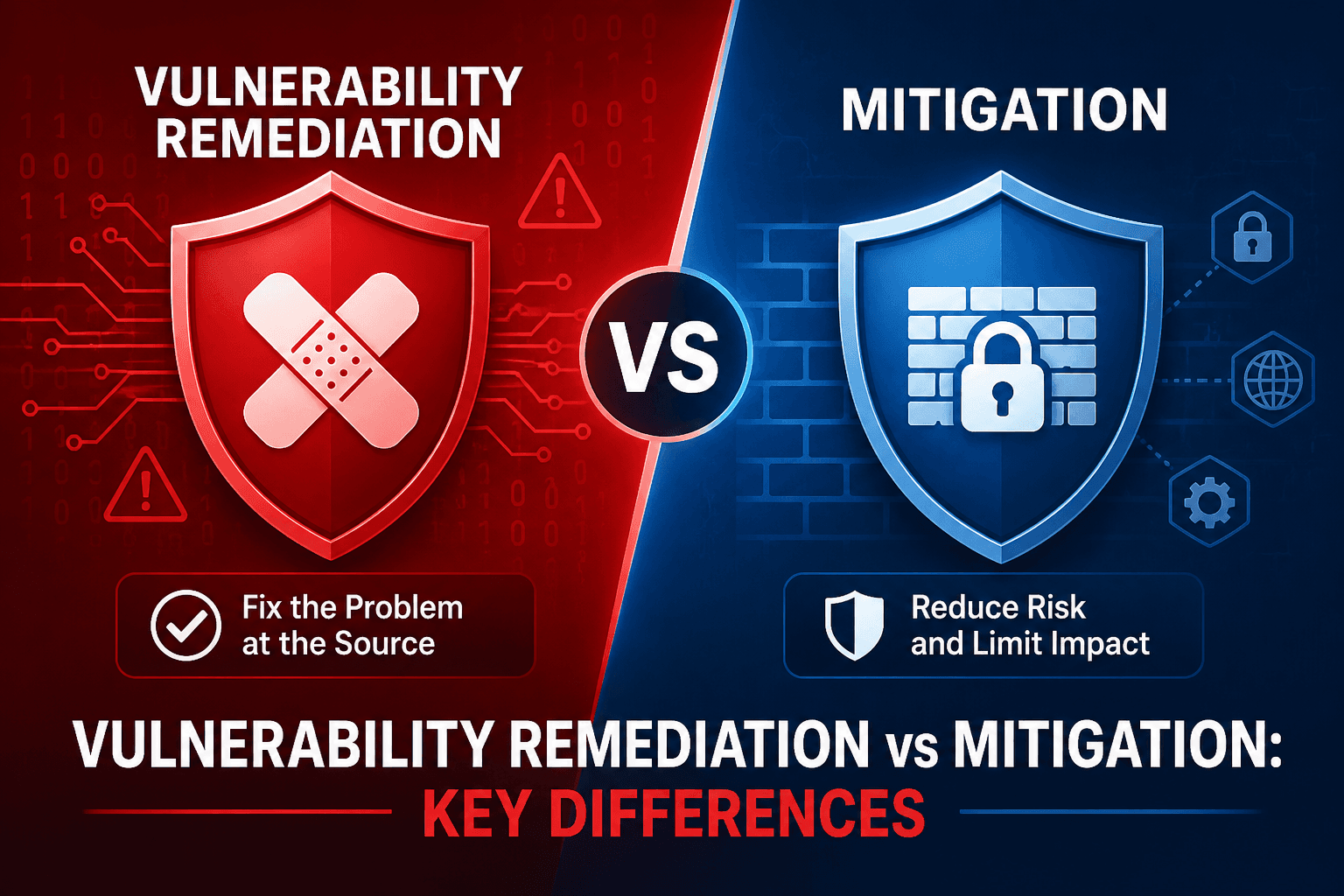
Vulnerability remediation refers to the complete elimination of a security vulnerability from a system. For example, this may involve patching software, fixing code flaws, or upgrading systems. Moreover, remediation ensures that the vulnerability no longer exists in any form. Therefore, it provides a permanent solution to a security issue. However, remediation often requires downtime, testing, and deployment efforts. As a result, it is usually planned carefully to avoid operational disruptions.
What is Vulnerability Mitigation
Vulnerability mitigation involves reducing the risk or impact of a vulnerability without fully eliminating it. For instance, security teams may apply firewall rules, access restrictions, or configuration changes. Additionally, mitigation acts as a temporary or compensating control. Consequently, it helps protect systems while a permanent fix is being developed. However, the underlying vulnerability still exists in the system. Therefore, mitigation is often used when immediate remediation is not feasible.
Related: Paid and Open-Source Vulnerability Management Tools
Key Differences Between Mitigation and Remediation
1. Definition Difference
Mitigation reduces the impact or likelihood of a vulnerability without fully eliminating it from the system. It applies compensating security controls such as restrictions, filters, or monitoring to limit exposure.
In contrast, remediation removes the vulnerability completely by fixing its root cause. Therefore, remediation ensures the issue no longer exists in any form within the environment.
2. Objective
Mitigation focuses on controlling and minimizing risk when an immediate fix is not available or practical. It helps maintain system protection and ensures business continuity during active threats.
However, remediation aims to permanently resolve the underlying security issue. As a result, it prevents future exploitation and strengthens long-term security posture.
3. Implementation Speed
Mitigation is generally implemented quickly because it relies on immediate security configurations or control adjustments. It does not require deep system changes or full validation cycles.
On the other hand, remediation takes more time because it involves patch development, testing, and deployment. Therefore, mitigation is often used as an urgent response mechanism.
Also Read: Penetration Testing vs Vulnerability Assessment
4. Cost Factor
Mitigation usually has lower short-term costs because it uses existing security tools and infrastructure. It avoids extensive development, testing, or system redesign efforts.
In contrast, remediation may involve higher costs due to engineering work and deployment processes. However, it reduces long-term expenses by permanently eliminating vulnerabilities.
5. Risk Level
Mitigation reduces risk exposure but does not fully eliminate the underlying vulnerability. Some residual risk remains even after controls are implemented.
In contrast, remediation removes the vulnerability entirely from the system. Therefore, it provides a stronger and more permanent reduction in security risk.
6. Use Case
Mitigation is used in urgent scenarios such as zero-day threats or when patches are not yet available. It provides immediate protection to prevent exploitation. Remediation is applied when a verified fix or update is available and ready for deployment. As a result, organizations often combine both depending on urgency and severity.
Must Read: PTaaS vs Traditional Pentesting
7. Technical Effort
Mitigation requires relatively lower technical effort because it mainly involves applying security rules, filters, or access controls. It rarely affects core system functionality.
However, remediation requires higher technical effort such as code fixes, debugging, or system updates. Therefore, it often involves collaboration between security and development teams.
8. Dependency
Mitigation does not depend on external vendors or software patch releases. It can be implemented internally using available security mechanisms.
In contrast, remediation often depends on vendor-provided updates or official fixes. Therefore, delays in vendor response can impact the remediation timeline.
9. Duration
Mitigation is temporary and remains in place only until a permanent solution is deployed. It is continuously monitored and adjusted based on threat conditions.
On the other hand, remediation provides a permanent fix that eliminates the vulnerability entirely. Therefore, it removes the need for ongoing compensating controls.
You May Also Like: Top Paid and Open-Source Vulnerability Management Tools
10. Security Outcome
Mitigation improves security by reducing exposure and limiting attack opportunities. However, it still leaves some level of residual risk in the system.
In contrast, remediation fully eliminates the vulnerability at its source. As a result, it delivers a complete and long-term security improvement.
Vulnerability Remediation vs Mitigation: In a Nutshell
Deciding Between Vulnerability Mitigation and Remediation
Organizations decide based on risk severity, resource availability, and operational constraints. Moreover, critical vulnerabilities often require immediate mitigation if remediation is delayed. In contrast, low-risk vulnerabilities may directly go through remediation without interim controls. Additionally, compliance requirements can influence the decision-making process. Therefore, security teams must evaluate both business and technical factors. Ultimately, the decision ensures balanced risk management.
How OraSec Can Help You?
OraSec provides expert VAPT Services (Vulnerability Assessment and Penetration Testing) to help organizations identify, prioritize, and address security risks effectively. Our team conducts in-depth vulnerability assessments to uncover weaknesses across your systems, applications, and networks. Moreover, we simulate real-world attacks through penetration testing to validate how exploitable those vulnerabilities are in practical scenarios. We not only identify issues but also guide you on whether to apply mitigation or remediation based on risk severity, business impact, and technical feasibility. Additionally, OraSec delivers clear, actionable reports with step-by-step recommendations, making it easier for your team to implement fixes quickly and efficiently.
Conclusion
Vulnerability remediation and mitigation are both essential components of a strong cybersecurity framework. While remediation eliminates risks permanently, mitigation provides immediate protection against exploitation. Moreover, combining both strategies ensures comprehensive defense against evolving threats. Therefore, organizations must adopt a structured approach to balance speed, cost, and security effectiveness. Ultimately, a well-integrated strategy strengthens resilience and reduces long-term cyber risk.
FAQs
What is the main difference between mitigation and remediation?
The main difference is that mitigation reduces risk temporarily, while remediation eliminates the vulnerability completely.
Is mitigation enough for cybersecurity protection?
Mitigation is not enough on its own because it leaves residual risk, so remediation is still required.
When should remediation be prioritized?
Remediation should be prioritized when a vulnerability has high severity and available fixes exist.
Can mitigation replace remediation?
No, mitigation cannot replace remediation; it only acts as a temporary control.
Why are both strategies important?
Both are important because mitigation provides immediate safety while remediation ensures long-term security.