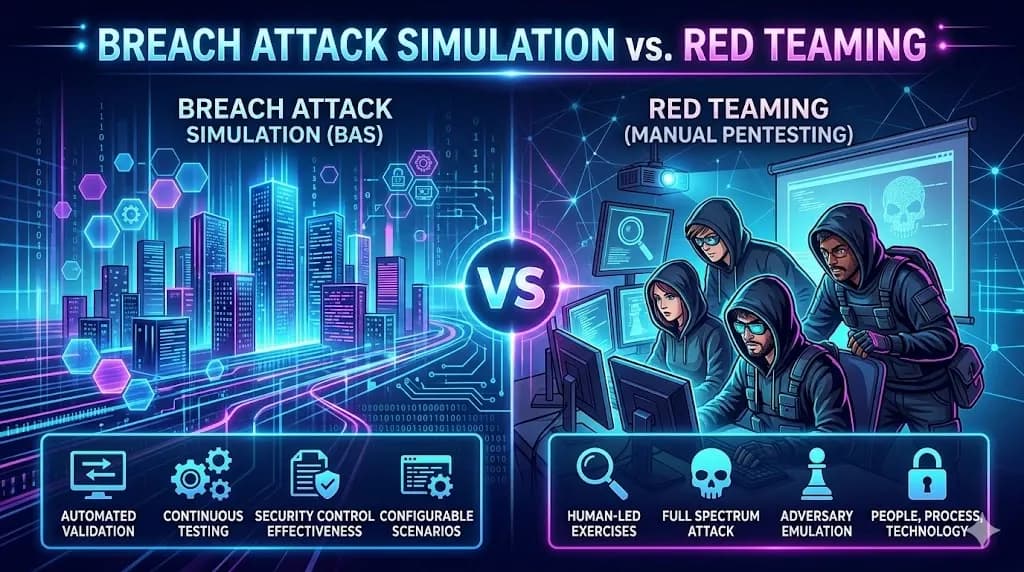
Modern cybersecurity environments face continuously evolving and highly sophisticated threats that target systems, networks, cloud platforms, APIs, and applications at multiple layers. Therefore, organizations increasingly adopt proactive security validation approaches to identify weaknesses before attackers exploit them in real-world scenarios. Breach Attack Simulation (BAS) and Red Teaming are two widely used techniques for advanced security assessment and continuous validation. Moreover, both simulate real-world attack behaviors but differ significantly in scope, depth, methodology, and execution style. Consequently, understanding their differences helps organizations strengthen their defense strategies effectively and improve long-term security resilience across complex digital environments.
Also Read: Penetration Testing vs Vulnerability Assessment
What Is Breach Attack Simulation (BAS)
Breach Attack Simulation (BAS) is an automated security testing approach that continuously simulates real-world attack techniques against an organization’s IT infrastructure, applications, and cloud environments. Moreover, it helps identify security gaps in systems, configurations, and defensive controls without requiring manual intervention. Therefore, security teams can validate defenses in real time and ensure continuous protection. Additionally, BAS runs safely in production-like environments to provide ongoing visibility, compliance support, and measurable security improvement across enterprise systems and evolving attack surfaces.
What Is Red Teaming
Red Teaming is a manual, adversary-driven security assessment where ethical hackers simulate real attackers to test an organization’s complete security posture, including people, processes, and technologies. Moreover, it includes advanced technical exploitation, social engineering, and stealth-based attack strategies. Therefore, it provides a deep, realistic, and intelligence-driven view of how attackers could bypass multiple layers of defense. Additionally, Red Teaming evaluates detection capabilities, incident response maturity, and organizational readiness against highly sophisticated and adaptive cyber threats.
How BAS Works in Cybersecurity
BAS works by automatically executing predefined attack simulations across systems, endpoints, networks, applications, and cloud workloads using security automation engines. Moreover, it continuously tests security controls such as firewalls, endpoint protection, email security, and SIEM systems. Therefore, it identifies whether existing defenses are properly detecting or blocking known attack patterns. Additionally, it generates real-time dashboards, reports, and actionable insights that help security teams quickly remediate issues and maintain continuous security validation across dynamic environments.
How Red Teaming Works in Cybersecurity
Red Teaming works by simulating a full attack lifecycle using real-world tactics, techniques, and procedures (TTPs) similar to advanced persistent threat actors. Moreover, ethical hackers manually identify vulnerabilities, exploit weaknesses, and escalate privileges step by step. Therefore, it tests not only technical systems but also human behavior, awareness, and organizational response mechanisms. Additionally, it evaluates incident detection speed, security monitoring effectiveness, and overall defense readiness under realistic and complex multi-stage attack scenarios.
Helpful for you: Red Team vs Blue Team vs Purple Team
Key Features of BAS Tools
- Automated attack simulation across enterprise IT environments continuously and safely
- Real-time security validation with continuous monitoring of controls and defenses
- Predefined and customizable attack scenario libraries based on known threat intelligence
- Integration with SIEM, SOAR, and endpoint security platforms for unified visibility
- Safe execution without disrupting production systems or business operations
- Compliance-focused reporting for regulatory and audit requirements
- Scalable testing across cloud, hybrid, and on-premise environments
Key Features of Red Teaming
- Human-led advanced attack simulations replicating real-world adversary behavior
- Multi-stage attack execution including reconnaissance, exploitation, and persistence
- Inclusion of social engineering, phishing, and physical security testing techniques
- Custom attack scenarios tailored to organizational infrastructure and threat profile
- Deep post-exploitation analysis to identify long-term security weaknesses
- Testing of people, processes, and technology under realistic attack pressure
- Advanced evasion techniques to bypass traditional security monitoring tools
Must Read: Top Anti-Phishing Tools for Businesses
Breach Attack Simulation vs Red Teaming
1. Automation vs Manual Expertise
BAS relies heavily on automation to execute continuous attack simulations across IT environments with speed and consistency. Moreover, it uses predefined attack templates to ensure repeatable and measurable results. Therefore, it is efficient for ongoing validation but limited in creativity.
Red Teaming, however, is fully manual and driven by experienced security professionals who think like real attackers. Moreover, they adapt strategies dynamically during engagement. Therefore, it delivers highly realistic, unpredictable, and intelligence-driven attack scenarios.
2. Scope of Testing
BAS focuses primarily on technical security controls such as endpoints, networks, applications, and cloud security configurations. Moreover, it validates whether defenses are functioning as expected across systems. Therefore, its scope is broad but mainly technical in nature.
Red Teaming covers a much wider scope, including technical infrastructure, human behavior, and physical security controls. Moreover, it evaluates how different layers interact under attack conditions. Therefore, it provides a more complete and holistic security assessment.
3. Speed of Execution
BAS runs automated tests frequently or continuously and provides near real-time results across large environments. Moreover, it helps security teams quickly identify and fix vulnerabilities. Therefore, it supports fast-paced and agile security operations.
Red Teaming takes significantly more time due to detailed planning, reconnaissance, and manual execution of attacks. Moreover, engagements may run for weeks depending on complexity. Therefore, results are slower but provide deeper and more actionable insights.
You May Also Like: Paid and Open-Source Vulnerability Management Tools
4. Depth of Analysis
BAS provides surface-level validation by checking whether security controls are blocking known threats effectively. Moreover, it focuses on detection and prevention capabilities. Therefore, it is ideal for operational security monitoring.
Red Teaming provides deep analytical insights into how attackers can fully compromise systems step by step. Moreover, it includes post-exploitation findings and lateral movement analysis. Therefore, it delivers strategic-level intelligence for improving overall security posture.
5. Realism of Attacks
BAS simulates known attack patterns using automated scripts and predefined scenarios based on threat intelligence databases. Moreover, it ensures controlled and repeatable testing conditions. Therefore, realism is moderate and structured.
Red Teaming replicates real attacker behavior without predefined limitations and adapts during execution based on findings. Moreover, it mimics advanced persistent threat groups. Therefore, it offers extremely high realism and unpredictability.
6. Frequency of Testing
BAS is designed for continuous or frequent execution, allowing organizations to validate security posture daily, weekly, or in real time. Moreover, it ensures constant visibility into evolving threats. Therefore, it supports ongoing security improvement.
Red Teaming is conducted periodically, usually annually or semi-annually, due to its complexity and resource requirements. Moreover, it focuses on deep strategic assessments. Therefore, it is less frequent but highly impactful.
Helpful for you: The Future of Red Teaming
7. Human Intelligence Involvement
BAS requires minimal human involvement after initial configuration and setup of test scenarios. Moreover, it relies on automation engines for execution. Therefore, it reduces manual workload significantly.
Red Teaming heavily depends on human intelligence, creativity, and adaptability throughout the engagement. Moreover, ethical hackers continuously modify attack paths based on system responses. Therefore, it closely reflects real-world attacker thinking and decision-making.
8. Cost and Resources
BAS is generally cost-effective and scalable across large environments without requiring extensive human resources. Moreover, it reduces operational overhead for security teams. Therefore, it is suitable for continuous enterprise use.
Red Teaming requires highly skilled professionals, longer engagement timelines, and higher financial investment. Moreover, it involves detailed planning and execution phases. Therefore, it is resource-intensive but delivers high-value insights.
9. Detection of Unknown Threats
BAS is mainly effective at identifying known vulnerabilities and misconfigurations based on existing threat libraries. Moreover, it ensures security controls are functioning properly. Therefore, unknown attack paths may remain undetected.
Red Teaming excels at uncovering unknown threats, hidden attack paths, and complex multi-stage exploitation chains. Moreover, it adapts dynamically to system responses. Therefore, it is highly effective for discovering previously unknown security gaps.
10. Impact on Security Strategy
BAS strengthens continuous security posture management by providing ongoing validation and measurable improvements over time. Moreover, it supports operational efficiency and compliance goals. Therefore, it enhances day-to-day security monitoring.
Red Teaming significantly improves strategic security maturity by revealing real-world attack scenarios and organizational weaknesses. Moreover, it helps leadership understand true risk exposure. Therefore, it supports long-term security transformation and resilience building.
Must Read: Top Reasons Why Cybersecurity Is Essential
Pros and Cons of Breach Attack Simulation
Pros of Breach Attack Simulation
- Continuous and automated security validation across environments
- Fast identification of misconfigurations and vulnerabilities
- Cost-effective solution for ongoing security monitoring
- Easy integration with modern security tools and platforms
- Strong support for compliance and audit requirements
- Scalable across large enterprise infrastructures
Cons of Breach Attack Simulation
- Limited creativity in attack simulation scenarios
- Focuses mainly on known threats and vulnerabilities
- Lacks human intelligence and adaptive attack behavior
- Cannot fully replicate real-world attacker decision-making
- May miss complex multi-stage attack chains
Pros and Cons of Red Teaming
Pros of Red Teaming
- Highly realistic and advanced attack simulation scenarios
- Identifies deep and hidden security vulnerabilities
- Tests people, processes, and technology together
- Improves incident response and detection capabilities
- Provides strategic-level cybersecurity insights
Cons of Red Teaming
- Expensive and resource-intensive engagement model
- Time-consuming planning and execution process
- Not suitable for continuous monitoring needs
- Requires highly skilled cybersecurity professionals
- Limited frequency due to operational complexity
When to Use Breach Attack Simulation
| Scenario | Recommendation |
|---|---|
| Continuous security monitoring required | Ideal choice |
| Large-scale IT or cloud environments | Highly suitable |
| Compliance and audit reporting needs | Strong fit |
| Quick validation of known vulnerabilities | Very effective |
| Deep adversary simulation required | Not suitable |
When to Use Red Teaming
| Scenario | Recommendation |
|---|---|
| Advanced threat simulation required | Ideal choice |
| High-value assets protection | Highly suitable |
| Incident response readiness testing | Strong fit |
| Strategic security assessment | Very effective |
| Continuous validation needs | Not suitable |
Breach Attack Simulation vs Red Teaming: In a Nutshell
| Aspect | Breach Attack Simulation (BAS) | Red Teaming |
|---|---|---|
| Purpose | Continuously validate security controls and detect known weaknesses across systems | Simulate real-world attackers to test full organizational security posture |
| Approach | Automated and tool-driven security testing using predefined attack scenarios | Manual, human-driven adversary simulation using real attacker tactics |
| Execution Style | Runs continuously or on scheduled intervals without disrupting operations | Performed as structured engagements with stealth, planning, and real attack paths |
| Realism Level | Moderate realism based on known threat patterns and attack libraries | Very high realism, mimicking advanced persistent threat (APT) behavior |
| Scope | Focuses on technical controls like endpoints, networks, applications, and cloud configurations | Covers people, processes, physical security, and technical systems together |
| Speed of Results | Provides fast, near real-time reports and dashboards | Takes longer due to manual execution and deep investigation |
| Skill Requirement | Minimal human involvement after setup, mostly automated operations | Requires highly skilled ethical hackers and security experts |
| Cost | Relatively cost-effective and scalable for continuous use | Expensive due to expertise, time, and complexity involved |
| Attack Coverage | Limited to predefined attack paths and known vulnerabilities | Explores unknown attack paths and adaptive exploitation techniques |
| Frequency | Continuous or frequent testing (daily, weekly, or real-time) | Periodic (quarterly, half-yearly, or yearly assessments) |
| Detection Focus | Validates whether existing security tools detect known threats | Tests how well SOC teams detect and respond to real attackers |
| Output | Automated reports, dashboards, and compliance-ready insights | Detailed findings with strategic recommendations and attack narratives |
| Use Case | Best for ongoing security monitoring and operational validation | Best for deep security assessments and maturity evaluation |
| Human Intelligence | Low dependency on human decision-making | High dependency on human creativity and adaptability |
| Business Impact | Improves continuous security hygiene and compliance readiness | Improves long-term security strategy and incident response maturity |
How Orasec Can Help You?
Orasec helps organizations strengthen their cybersecurity posture through advanced Red Teaming services, penetration testing, vulnerability assessments (VAPT), and adversary simulation engagements. Moreover, Orasec simulates real-world attack scenarios to identify hidden security gaps across applications, networks, cloud environments, APIs, and enterprise systems. Therefore, businesses gain complete visibility into their risk exposure and attack surface. Additionally, Orasec supports continuous security improvement through proactive testing, threat analysis, and security evaluation strategies, helping organizations build stronger, smarter, and more resilient defense systems.
Conclusion
Breach Attack Simulation and Red Teaming are both powerful security validation techniques used in modern cybersecurity environments. Moreover, each plays a distinct role in identifying vulnerabilities and improving defense mechanisms. Therefore, BAS is best suited for continuous monitoring and operational security, while Red Teaming is ideal for deep, realistic adversary simulation. Additionally, using both approaches together creates a stronger and more adaptive cybersecurity strategy. Ultimately, organizations that invest in both methods achieve higher resilience, better threat visibility, and improved long-term security posture.
FAQs
What is the main difference between BAS and Red Teaming?
BAS is automated and continuous, while Red Teaming is manual, human-driven, and highly realistic in nature.
Which is better for cybersecurity testing?
Both are important. BAS is ideal for continuous validation, while Red Teaming is best for deep security assessments.
Can BAS replace Red Teaming?
No, BAS cannot replace Red Teaming because it lacks human creativity and advanced attack simulation depth.
How often should Red Teaming be performed?
It is typically performed once or twice a year depending on organizational risk and maturity.
Is BAS suitable for small businesses?
Yes, BAS is scalable and can be used by both small and large organizations for continuous security monitoring.