Cybersecurity threats are evolving faster than ever. Businesses now face continuous risks from ransomware, misconfigured systems, insecure APIs, cloud vulnerabilities, and hidden attack paths. As organizations expand their digital infrastructure, regular security testing becomes essential for protecting sensitive data and maintaining customer trust. Two common approaches businesses use are PTaaS (Penetration Testing as a Service) and traditional penetration testing. While both aim to identify security weaknesses, they differ greatly in testing frequency, reporting methods, collaboration, scalability, and long-term visibility.
In this guide, you will learn how PTaaS and traditional pentesting work, their advantages and limitations, common use cases, and which option is best for your business.
What Is PTaaS (Penetration Testing as a Service)?
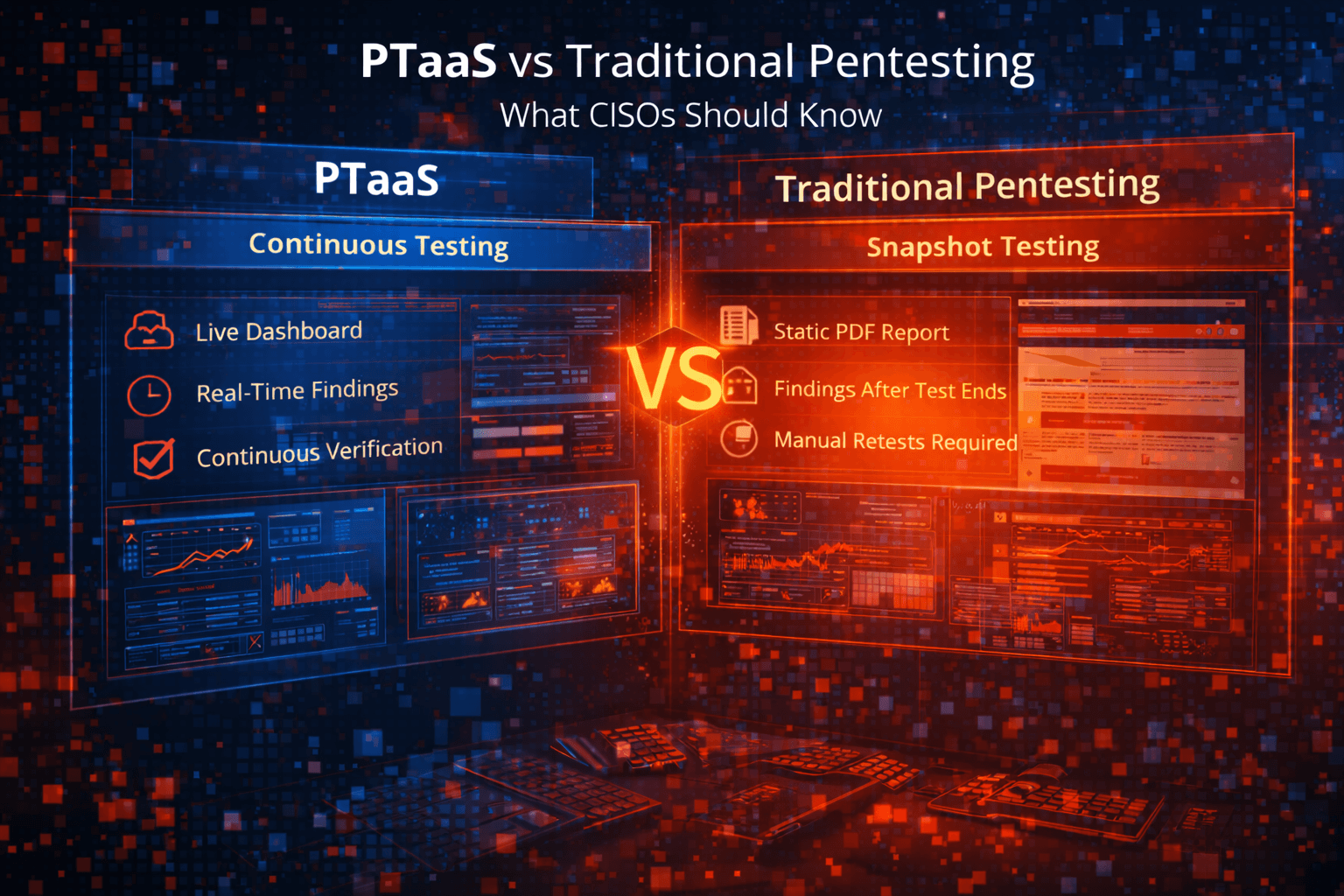
PTaaS, or Penetration Testing as a Service, is a modern cybersecurity testing model that combines manual penetration testing with continuous security validation through a cloud-based platform. Instead of receiving a single report after testing ends, businesses gain ongoing visibility into vulnerabilities, remediation progress, and real-time collaboration with security experts. PTaaS platforms typically provide dashboards, live reporting, ticketing integration, retesting capabilities, and continuous communication between security teams and developers. This approach is designed for organizations that operate in fast-moving environments with regular software updates and continuous deployments.
Unlike traditional testing, PTaaS supports a more agile security workflow. Teams can quickly identify vulnerabilities, prioritize remediation efforts, and validate fixes without waiting months for another assessment cycle.
Key Features of PTaaS
- Continuous vulnerability validation
- Real-time reporting dashboards
- Faster remediation tracking
- Integrated collaboration with developers
- Retesting on demand
- Scalable cloud-based testing environment
- Better visibility into security posture over time
- Suitable for DevSecOps and agile workflows
Also Read: What Is Phishing-as-a-Service (PhaaS)
What Is Traditional Pentesting?
Traditional penetration testing is a point-in-time security assessment performed by ethical hackers to identify vulnerabilities within systems, networks, applications, or infrastructure. The engagement usually follows a fixed scope, predefined timeline, and formal reporting process. During the assessment, security professionals simulate real-world cyberattacks to uncover weaknesses that attackers could exploit. Once testing is complete, the organization receives a detailed report containing findings, risk levels, proof of exploitation, and remediation recommendations.
Traditional pentesting is commonly conducted annually, quarterly, or before major compliance audits. It remains one of the most trusted methods for deep manual security analysis and regulatory validation.
Key Features of Traditional Pentesting
- One-time or scheduled assessments
- Deep manual testing methodologies
- Comprehensive security reports
- Compliance-focused testing approach
- Fixed engagement scope and timeline
- External validation of security posture
- Human-led attack simulation
Helpful for you: Penetration Testing vs Vulnerability Assessment
Common Use Cases of PTaaS
Continuous Security Monitoring
Organizations with rapidly changing applications use PTaaS to maintain ongoing visibility into vulnerabilities and security risks.
Agile and DevSecOps Environments
Development teams using continuous integration and deployment benefit from faster testing and remediation workflows.
SaaS and Cloud-Based Applications
Cloud-native businesses often require continuous testing due to frequent infrastructure and application updates.
Frequent Product Releases
Companies releasing weekly or monthly updates use PTaaS to identify vulnerabilities before deployment.
Security Collaboration Across Teams
PTaaS helps developers, security teams, and management work together through centralized dashboards and tracking systems.
Startup and Scaling Businesses
Growing companies use PTaaS for scalable security testing without managing large in-house security operations.
Must Read: How Streamlining Penetration Testing Enhances Network Security
Common Use Cases of Traditional Pentesting
Compliance Requirements
Many regulations require formal penetration testing reports for audits and certifications.
Annual Security Assessments
Organizations perform yearly pentests to evaluate their overall security posture.
High-Risk Infrastructure Testing
Critical infrastructure environments often require detailed manual testing from experienced ethical hackers.
Pre-Launch Security Validation
Businesses conduct traditional pentests before launching major applications or platforms.
Third-Party Security Assurance
Companies use independent pentesting firms to validate security controls for clients and stakeholders.
Internal Network Security Reviews
Traditional pentesting is commonly used for internal infrastructure and segmented network testing.
PTaaS vs Traditional Pentesting: 10 Key Differences
1. Testing Frequency
PTaaS provides continuous or recurring security testing throughout the year. Businesses can identify vulnerabilities during development instead of waiting for yearly assessments. This helps teams respond to risks faster and maintain better security visibility. It is highly useful for organizations with frequent updates and deployments.
Traditional pentesting is usually conducted once or twice per year based on business requirements. Security testing happens during a fixed engagement period with a defined scope. While it provides detailed findings, new vulnerabilities may appear between testing cycles. Additional assessments are often needed to maintain updated security coverage.
2. Reporting Style
PTaaS offers live dashboards and real-time reporting for ongoing visibility into vulnerabilities. Teams can track remediation progress, severity levels, and retesting results instantly. This makes the security process more collaborative and actionable. Real-time insights also help organizations prioritize critical risks faster.
Traditional pentesting delivers findings through detailed PDF reports after testing is completed. These reports include vulnerability details, proof of exploitation, and remediation guidance. However, reporting is mostly static and limited to the assessment period. Any updates or retesting may require a separate engagement.
3. Collaboration
PTaaS supports continuous collaboration between developers, security teams, and testers. Many platforms include ticketing systems, comments, and remediation tracking features. This improves communication and speeds up vulnerability resolution. Teams can work together more efficiently throughout the testing lifecycle.
Traditional pentesting usually involves limited collaboration during the engagement. Communication mainly occurs during kickoff meetings, testing updates, and final report delivery. Developers may not interact directly with testers throughout the process. This can slow remediation discussions and fix validation.
You May Also Like: Vulnerability Remediation vs Mitigation
4. Speed of Remediation
PTaaS allows organizations to fix and validate vulnerabilities much faster. Continuous retesting and live communication help security teams confirm remediation quickly. Businesses can reduce exposure time and respond to threats more efficiently. This supports stronger long-term security management.
Traditional pentesting may involve slower remediation validation processes. Once the assessment ends, organizations often need separate retesting engagements to verify fixes. This can delay vulnerability resolution for weeks or months. Security risks may remain active during that period.
5. Scalability
PTaaS scales effectively for growing businesses, cloud platforms, and large digital environments. Organizations can continuously test applications, APIs, and infrastructure as they expand. This flexibility supports modern development and deployment models. It also helps businesses maintain consistent security visibility.
Scaling traditional pentesting often increases project costs and scheduling complexity. Larger infrastructures usually require separate engagements and additional resources. This can make testing slower for rapidly growing organizations. Managing continuous security coverage becomes more challenging over time.
6. Cost Structure
PTaaS commonly follows a subscription or recurring pricing model. This provides predictable costs and ongoing access to testing services and reporting platforms. Businesses can manage budgets more efficiently over long periods. Continuous testing also reduces the need for repeated standalone engagements.
Traditional pentesting usually follows a one-time project-based pricing structure. Costs depend on scope, infrastructure size, and testing complexity. Additional assessments and retesting often increase overall expenses. Budget planning may become less predictable for frequent testing needs.
7. Visibility Into Security Posture
PTaaS provides ongoing visibility into vulnerabilities, remediation progress, and security trends. Businesses can monitor their security posture continuously instead of relying on periodic snapshots. This helps teams identify recurring weaknesses more effectively. Long-term visibility improves overall risk management.
Traditional pentesting offers visibility only during the testing engagement period. Once the assessment ends, organizations may lose insight into newly emerging risks. Security findings can become outdated as systems change over time. Continuous monitoring usually requires additional testing cycles.
Helpful for you: How to Prepare Your Organization for a Pentest
8. Suitability for Agile Development
PTaaS works well with agile development and DevSecOps environments. Continuous testing supports fast deployments and regular software updates. Developers can address vulnerabilities during active development cycles. This helps organizations maintain security without slowing innovation.
Traditional pentesting may not fully align with fast-moving agile workflows. Fixed schedules and delayed reporting can slow release cycles. Security validation often happens after development phases are completed. This may create bottlenecks in rapidly changing environments.
9. Compliance Support
Some PTaaS providers support compliance reporting and regulatory requirements. Continuous documentation and testing records can help organizations improve audit readiness. However, acceptance depends on the industry and specific compliance standards. Businesses should confirm requirements before relying solely on PTaaS.
Traditional pentesting is widely accepted for compliance audits and regulatory assessments. Many standards specifically require formal penetration testing reports from independent testers. This makes traditional assessments highly valuable for regulated industries. Detailed documentation also supports external security validation.
10. Depth of Assessment
PTaaS focuses on continuous visibility and efficient vulnerability management across evolving systems. It helps businesses identify risks quickly and maintain ongoing security oversight. Many providers combine automated scanning with manual testing techniques. This creates a proactive and flexible security approach.
Traditional pentesting often delivers deeper manual analysis during a dedicated assessment period. Ethical hackers spend more time simulating complex real-world attack scenarios. This approach can uncover advanced vulnerabilities and hidden attack paths. It is especially valuable for critical infrastructure and high-risk environments.
10. Depth of Assessment
PTaaS focuses on continuous risk visibility and efficient vulnerability management across evolving systems.
Traditional pentesting often provides deeper manual analysis during a dedicated engagement period.
Benefits of PTaaS
- Continuous visibility into vulnerabilities and attack surfaces
- Faster remediation through live collaboration and retesting
- Better support for agile development and DevSecOps
- Centralized dashboards for tracking security issues
- Reduced time between discovery and resolution
- Scalable testing for cloud and SaaS environments
- Improved communication between developers and security teams
- Flexible testing schedules based on business needs
- Better long-term understanding of security posture
- Faster adaptation to infrastructure and application changes
- Easier prioritization of critical vulnerabilities
- More proactive approach to cybersecurity management
Challenges of PTaaS
- Subscription costs may increase over time
- Some businesses may prefer traditional formal reporting formats
- Requires active internal collaboration for maximum effectiveness
- Smaller organizations may underutilize continuous testing features
- Compliance acceptance varies by industry and regulation
- Integration with internal systems may require setup time
- Continuous monitoring can create alert fatigue without proper prioritization
- Some PTaaS platforms vary in manual testing depth
Benefits of Traditional Pentesting
- Deep manual security analysis by experienced ethical hackers
- Strong compliance and audit acceptance
- Comprehensive final security reports
- Effective for identifying complex attack paths
- Trusted methodology across regulated industries
- Useful for validating critical infrastructure security
- Independent external assessment improves stakeholder confidence
- Clear scope and engagement structure
- Suitable for high-security enterprise environments
- Detailed proof-of-concept exploitation examples
Challenges of Traditional Pentesting
- Limited visibility between testing cycles
- Slower remediation validation process
- Static reports can become outdated quickly
- Higher costs for repeated testing engagements
- Less suitable for rapidly changing environments
- Delayed communication during remediation phases
- Scheduling assessments may take time
- Security gaps may remain unnoticed between assessments
- Limited integration with DevOps and CI/CD workflows
PTaaS vs Traditional Pentesting: In a Nutshell
| Feature | PTaaS | Traditional Pentesting |
|---|---|---|
| Testing Model | Continuous or recurring | One-time or scheduled |
| Reporting | Real-time dashboards | Static reports |
| Collaboration | Continuous collaboration | Limited communication |
| Retesting | On-demand | Usually separate engagement |
| Best for Agile Teams | Excellent | Moderate |
| Compliance Support | Varies | Strong |
| Visibility | Ongoing | Point-in-time |
| Scalability | High | Moderate |
| Cost Structure | Subscription-based | Project-based |
| Remediation Speed | Faster | Slower |
| Cloud Environment Support | Excellent | Good |
| Manual Testing Depth | Moderate to High | High |
| Best Use Case | Continuous security management | Formal security validation |
Which Option Is Best for Your Business? — PTaaS vs Traditional Pentesting
The right choice depends on your business model, infrastructure, compliance requirements, and development workflow.
PTaaS is often the better choice for organizations that operate in fast-paced environments with continuous deployments, cloud-native applications, and agile development practices. It provides ongoing visibility and allows teams to fix vulnerabilities quickly before they become major threats.
Traditional pentesting is ideal for businesses that require formal compliance assessments, deep manual security reviews, or independent third-party validation. It remains highly valuable for enterprise environments, regulated industries, and critical infrastructure testing.
In many cases, businesses achieve the best security outcomes by combining both approaches. Continuous PTaaS monitoring can improve day-to-day security, while periodic traditional pentesting provides deeper validation and compliance support.
How Orasec Can Help You
Orasec provides both PTaaS and traditional penetration testing services to help businesses strengthen their cybersecurity posture. Our security experts perform detailed assessments designed to identify real-world vulnerabilities across applications, networks, APIs, cloud environments, and infrastructure. Whether you need continuous security testing through PTaaS or a comprehensive traditional pentest engagement, our team delivers actionable insights tailored to your business needs.
Conclusion
Both PTaaS and traditional penetration testing play important roles in modern cybersecurity strategies. While they share the same goal of identifying security weaknesses, they differ significantly in methodology, reporting, collaboration, and long-term visibility. PTaaS offers continuous security validation for modern agile environments, while traditional pentesting provides deep manual assessments and strong compliance support. Choosing the right approach depends on your organization’s infrastructure, risk exposure, development speed, and regulatory requirements.
Businesses that combine proactive monitoring with expert-led assessments often achieve stronger long-term protection against evolving cyber threats.
FAQs
Is PTaaS better than traditional pentesting?
PTaaS is better for organizations that need continuous security testing and faster remediation workflows. Traditional pentesting is better for formal compliance and deep manual assessments.
Does PTaaS replace traditional penetration testing?
Not entirely. Many businesses use PTaaS alongside traditional pentesting to achieve both continuous monitoring and formal security validation.
Which industries benefit most from PTaaS?
SaaS companies, cloud-based businesses, fintech platforms, startups, and organizations using agile development often benefit most from PTaaS.
How often should penetration testing be performed?
Most businesses should perform penetration testing at least annually. High-risk or rapidly changing environments may require more frequent testing.
Is traditional pentesting still important?
Yes. Traditional pentesting remains highly valuable for compliance, deep manual analysis, and validating critical systems.
Can small businesses use PTaaS?
Yes. Many PTaaS providers offer scalable solutions suitable for startups and small businesses looking for continuous security visibility.
What types of systems can be tested?
Both PTaaS and traditional pentesting can assess web applications, APIs, mobile apps, cloud infrastructure, internal networks, wireless environments, and external systems.