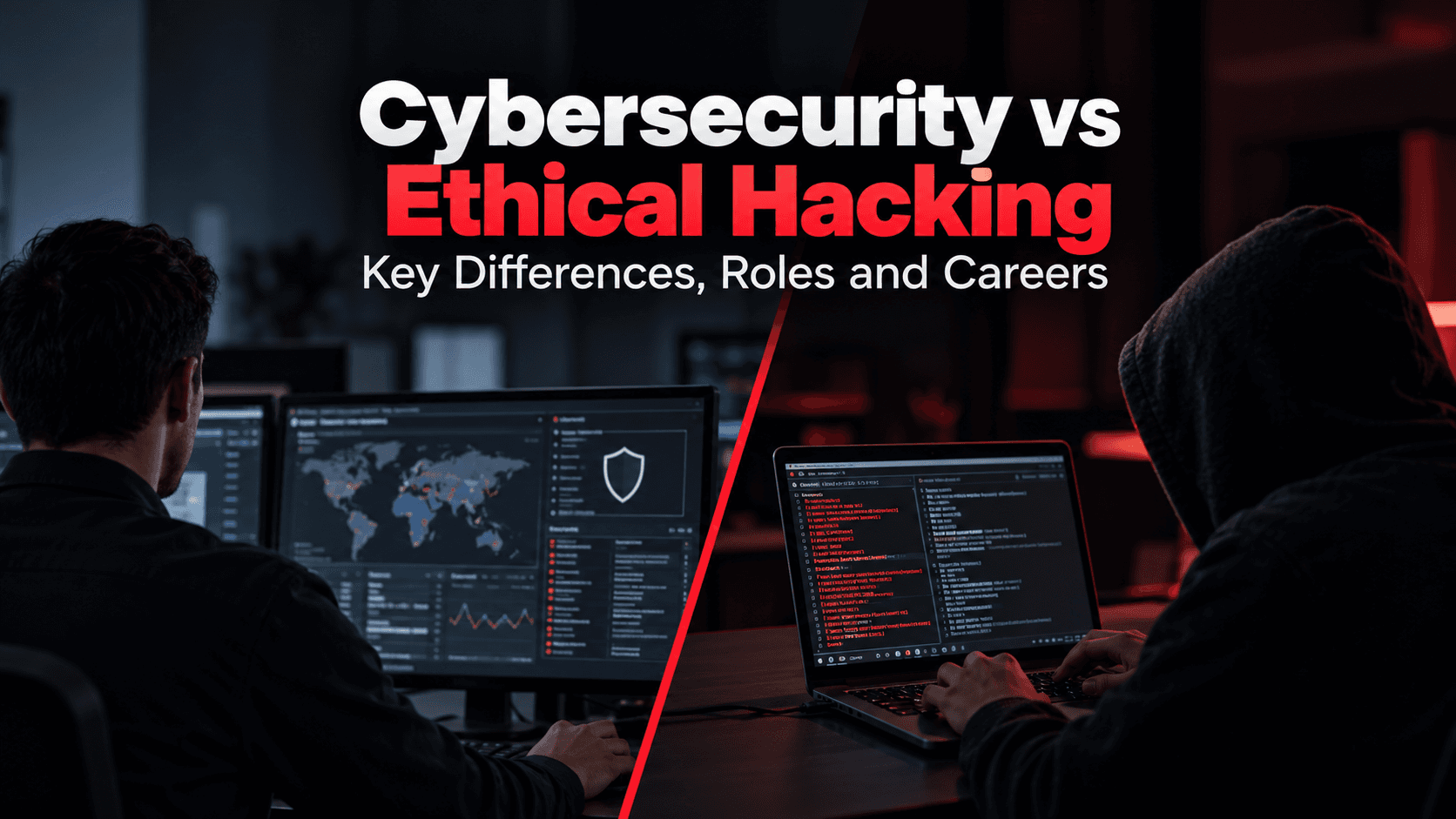
Cybersecurity is the work of protecting an organization's systems, data, and people. Ethical hacking is one part of it: authorized testers attack those systems the way a real attacker would, so weaknesses get found and fixed first. Defenders build and run the controls. Ethical hackers check whether those controls hold up under a real attempt to get around them, which is what a penetration test is designed to show.
Is ethical hacking part of cybersecurity?
Yes. Ethical hacking is a specialty within cybersecurity that tests defenses by attacking them with permission.
Which is better, cybersecurity or ethical hacking?
Neither is better. Cybersecurity offers more entry points, while ethical hacking suits people who enjoy offensive, hands-on testing.
Who earns more, an ethical hacker or a cybersecurity professional?
Neither always earns more. Pay depends mainly on experience, specialization, location, and employer, not the job title.
Is ethical hacking in demand?
Security skills are in demand. BLS projects 29% job growth for information security analysts from 2024 to 2034.
What is the future of cybersecurity?
Steady growth and more specialization, with AI now the fastest-rising skill area on both the defensive and offensive sides.
Key Takeaways
- Ethical hacking is a specialty inside cybersecurity, not a rival to it.
- Cybersecurity is mostly defensive and continuous; ethical hacking is offensive and engagement-based.
- Both start from the same foundations in networking, systems, and identity.
- The clearest difference is the question each asks: how do we defend this, versus what could an attacker do here.
- Organizations need both. One builds the controls, the other proves whether they hold.
What Is Cybersecurity?
Cybersecurity is the practice of protecting systems, networks, applications, and data from unauthorized access, disruption, and theft. It is an ongoing program, not a one-time project. The NIST Cybersecurity Framework 2.0 organizes it into six functions:
- Govern: set strategy, policies, roles, and risk tolerance.
- Identify: know your assets, data, and risks.
- Protect: apply safeguards such as access control, encryption, hardening, and training.
- Detect: spot attacks and anomalies through logging and monitoring.
- Respond: contain and investigate incidents.
- Recover: restore operations and learn from what happened.
Most cybersecurity work is defensive and continuous: managing identities, tuning detections, handling alerts, running vulnerability scans, and supporting frameworks such as SOC 2, ISO 27001, and PCI DSS.
Also Read: Why Cybersecurity Is Essential
What Is Ethical Hacking?
Ethical hacking is the authorized use of attacker techniques to find security weaknesses before a real attacker does. Written authorization and an agreed testing scope are what separate it from a real attack, and the work must also comply with applicable laws and contractual restrictions.
Penetration testing is the most common form: a time-boxed assessment of a defined target, such as a web application, API, internal network, or cloud environment, usually following a structured, repeatable methodology. Red teaming and bug bounty programs are other forms.
Related: Penetration Testing Types and Standards
What ethical hacking adds is evidence of impact. On a hotel booking platform we assessed, a tester changed the member_id value in a loyalty API request and received another customer's profile. The IDs were sequential, so up to 2.7 million customer records could have been exposed if the flaw had been found by an attacker first. It was fixed the same day, and a retest returned an access error. The flaw was a missing ownership check in an otherwise working API, which is exactly why manual authorization testing matters.
Helpful for you: Red Team vs Blue Team vs Purple Team
How Cybersecurity and Ethical Hacking Work Together
Defenders and ethical hackers work on the same problem from opposite sides. The security team builds controls, testers try to get past them, and the findings go back to the team to fix. A later test checks whether those fixes hold. When both sides work together during an exercise and share what they see in real time, it's often called purple teaming.
Aspect | Cybersecurity | Ethical Hacking |
|---|---|---|
What it is | The full discipline of protecting systems, data, and people | A specialty within cybersecurity that tests defenses by attacking them |
Main question | How do we prevent, detect, and recover from attacks? | What could an attacker do here? |
Approach | Mostly defensive and continuous | Offensive and engagement-based |
Timeframe | Ongoing | Scheduled tests, often several days to a few weeks |
Typical output | Controls, policies, alerts, incident reports | Findings with evidence of exploitability and fix guidance |
Permission | Works within the organization's own systems and policies | Requires explicit written authorization and an agreed scope |
Success looks like | Fewer incidents, faster detection and recovery | Weaknesses found and fixed before attackers exploit them |
Cybersecurity vs Ethical Hacking: 10 Key Differences
1. Purpose and Objectives
Cybersecurity aims to keep risk at a level the business accepts. Ethical hacking aims to find gaps in that protection so they can be closed.
2. Scope of Work
Cybersecurity spans people, processes, technology, vendors, and compliance. An ethical hacking engagement covers a defined scope, such as one application or an Active Directory domain.
3. Security Approach
Cybersecurity is largely defensive. Ethical hacking is offensive: it looks for gaps and shows how small issues can chain into real attack paths.
4. Roles and Responsibilities
Cybersecurity professionals design, run, and monitor controls and respond to incidents. Ethical hackers plan and run tests, then document each step so findings can be reproduced and fixed.
5. Testing and Assessment Methods
Defensive teams use scanning, configuration reviews, audits, and log analysis. Ethical hackers add manual exploitation, privilege escalation, and lateral movement.
Also Read: Penetration Testing vs Vulnerability Assessment
6. Tools and Technologies
Defenders rely on SIEM, EDR, firewalls, and identity platforms. Testers use tools such as Burp Suite, Nmap, Metasploit, and BloodHound. Many tools, including scanners, are used on both sides.
7. Skills and Knowledge
Cybersecurity roles need breadth across networking, systems, cloud, identity, and risk. Ethical hacking builds on that foundation with depth in attack techniques.
8. Certifications and Qualifications
CompTIA Security+ is a common entry point, and ISC2 CISSP targets experienced practitioners. For testers, EC-Council CEH and OffSec OSCP are common, and OSCP uses a hands-on exam. None is universally required, though some employers and government contracts require specific certifications.
9. Career Opportunities
Cybersecurity offers more paths, from SOC analyst to security leadership. Ethical hacking is a narrower set of roles. For information security analysts, the US Bureau of Labor Statistics reports a May 2024 median pay of $124,910 and projects 29% growth from 2024 to 2034. BLS doesn't publish a separate figure for ethical hackers.
10. Reporting and Outcomes
Defensive teams report on incidents, detection times, open vulnerabilities, and compliance. Ethical hackers deliver a test report covering scope, findings, impact, and fixes, often followed by a retest.
Must Read: Penetration Testing Report Example
Roles and Responsibilities of Cybersecurity Professionals
- Monitor for threats: review SIEM, EDR, and cloud alerts and separate real incidents from noise.
- Respond to incidents: contain affected accounts and systems, investigate, and support recovery.
- Manage access: run identity controls, enforce MFA, and review privileged accounts.
- Harden systems: apply secure configurations to servers, endpoints, network devices, and cloud services.
- Manage vulnerabilities: scan, prioritize by risk, and track fixes to closure.
- Maintain compliance: keep policies current and gather audit evidence.
- Assess third-party risk: review suppliers that handle sensitive data or systems.
- Train staff: run security awareness and phishing training.
Roles and Responsibilities of Ethical Hackers
- Agree the scope and rules: confirm in writing what can be tested, when, and how.
- Run reconnaissance: map the attack surface, including forgotten subdomains and exposed services.
- Find and confirm weaknesses: test for issues such as broken access control, injection, and weak authentication.
- Show impact: demonstrate how a foothold could lead to higher access, within the agreed scope.
- Test people and processes: perform approved phishing or physical security tests when in scope.
- Minimize disruption: protect production systems and handle any data accessed with care.
- Report promptly: escalate critical issues as agreed in the rules of engagement.
- Write the report and retest: document evidence, impact, and fixes, then confirm the fixes work.
Tools Used in Cybersecurity vs Ethical Hacking
Tool choice follows the job. Defenders need visibility across the environment, and testers need tools that help them find and confirm weaknesses. Many tools appear on both sides.
Area | Cybersecurity Tools | Ethical Hacking Tools |
|---|---|---|
Monitoring and detection | SIEM platforms such as Splunk and Microsoft Sentinel | Used mainly to check whether test activity was detected |
Endpoint | EDR such as CrowdStrike Falcon and Microsoft Defender for Endpoint | Post-exploitation and C2 frameworks, to test whether EDR catches their activity |
Network | Firewalls, IDS/IPS such as Suricata, and Zeek | Nmap for discovery, Wireshark for traffic analysis, Responder to capture NetNTLM data |
Vulnerabilities | Scanners such as Tenable Nessus, Qualys, and Rapid7 InsightVM | The same scanners as a starting point, then manual verification and in-scope exploitation with Metasploit |
Web and API | WAFs, DAST tools, and code scanning in CI/CD | Burp Suite, ZAP, ffuf, and sqlmap |
Identity and Active Directory | Identity platforms, PAM, and AD auditing tools | BloodHound for attack paths, Impacket, NetExec, and Certipy for AD CS |
Passwords | Password managers, MFA, and breached-password checks | Hashcat and John the Ripper to test captured hashes |
Cloud | CSPM tools, AWS Security Hub, and Microsoft Defender for Cloud | ScoutSuite, Prowler, and Pacu |
Skills Required for Cybersecurity
- Networking: TCP/IP, DNS, routing, VPNs, and firewalls.
- Operating systems: Windows and Linux administration, logs, and permissions.
- Identity and access: Active Directory, Entra ID, SSO, MFA, and least privilege.
- Cloud security: IAM, logging, and secure configuration in AWS, Azure, or Google Cloud.
- Detection and response: reading logs, writing detection rules, and handling incidents.
- Risk and compliance: frameworks such as NIST CSF, ISO 27001, SOC 2, and PCI DSS.
- Scripting: Python or PowerShell for automating repetitive security tasks.
- Communication: explaining risk to engineers, executives, and auditors.
Skills Required for Ethical Hacking
- Strong fundamentals: the same networking, systems, and identity knowledge defenders need.
- Web and API security: HTTP, authentication, sessions, and common flaws such as those in the OWASP Top 10.
- Active Directory attacks: Kerberos, NTLM relay, delegation abuse, and AD CS misconfigurations.
- Privilege escalation: moving from limited access to higher privileges on Windows and Linux.
- Scripting and code reading: Python, Bash, or PowerShell, plus enough code literacy to spot flaws.
- Judgment and ethics: staying in scope and protecting any data accessed.
- Report writing: explaining findings so developers can fix them and executives understand the impact.
- Continuous learning: keeping skills current through new techniques, vulnerabilities, and hands-on labs.
Typical Job Roles: Cybersecurity vs Ethical Hacking
Job titles vary, and many roles blend both sides.
Role | Path | What the Role Usually Involves |
|---|---|---|
SOC analyst | Cybersecurity | Monitoring alerts, triaging events, and escalating incidents |
Security engineer | Cybersecurity | Building and maintaining security tools and controls |
Incident responder | Cybersecurity | Investigating and containing incidents and supporting recovery |
Cloud security engineer | Cybersecurity | Securing cloud accounts, identities, and workloads |
GRC analyst | Cybersecurity | Managing risk, policies, audits, and compliance |
Security architect | Cybersecurity | Designing secure systems and setting technical standards |
CISO | Cybersecurity | Leading security strategy, budget, and risk management |
Penetration tester | Ethical hacking | Running scoped tests of networks, applications, APIs, and cloud |
Red team operator | Ethical hacking | Simulating a real attacker to test detection and response |
Application security tester | Ethical hacking | Testing web, mobile, and API applications and reviewing code |
Security researcher | Ethical hacking | Finding new vulnerabilities, often with coordinated disclosure |
Bug bounty hunter | Ethical hacking | Reporting flaws through public or private bounty programs |
How OraSec Can Help
OraSec provides the ethical hacking side of your security program. Our testers assess your networks, web applications, APIs, cloud environments, and Active Directory the way a real attacker would, then show your team what they could reach and how. Each report includes evidence, business impact, and clear remediation steps, and we retest once fixes are in place. We work within your agreed scope and testing windows to keep disruption to a minimum. For automated coverage combined with manual depth, see our vulnerability assessment and penetration testing service.
Recent News: CVE-2026-109618 vs CVE-2026-109619
Conclusion
Cybersecurity and ethical hacking aren't competitors. Cybersecurity protects an organization every day, and ethical hacking tests whether that protection holds up against someone trying to break it. Organizations benefit from both, and both career paths start from the same foundations. If you want to know what an attacker could do in your environment today, talk to our team.
Frequently Asked Questions
Is ethical hacking legal?
Yes, when authorized, properly scoped, and compliant with applicable laws and contracts. Unauthorized testing can violate laws such as the Computer Fraud and Abuse Act.
Is ethical hacking the same as penetration testing?
Not exactly. Penetration testing is one form of ethical hacking, which also covers red teaming, bug bounty research, and social engineering tests.
What is the difference between an ethical hacker and a black hat hacker?
Permission and intent. Ethical hackers test with authorization and report findings, while black hat hackers break in without permission for gain or disruption.
Do ethical hackers need to know programming?
Not at a developer level, but scripting and code reading help testers automate tasks, adapt tools, and spot flaws in applications.
Do you need a degree for a cybersecurity or ethical hacking career?
Not always. BLS lists a bachelor's degree as typical for information security analysts, but many employers also value skills, certifications, and experience.
Can an organization rely on its internal security team instead of ethical hackers?
Internal testing helps, but independent testers add an outside view. PCI DSS requires a qualified tester with organizational independence from the systems tested.